Hello DC,
Can you point me in the right direction to ID a longhorned beetle species that is causing havoc on almond trees?
Adult around 40mm, looks black but on close inspection slightly reddish-black, antennae "horns" not longer than body.
Larva massive when adult, about 50mm long.
Thanks for any info!
RB
For D Cilia - Q about Longhorned beetles in Malta
Moderators: AlanOuten, MWP admin, IL-PINE

Hey! I assume the larva is a wood-eating grub, sounds like a species from the Cerambycidae family. There are some 38 species in Malta so perhaps identification is not so easy.
You might try sending pictures in an email to specialists (check PM) or browse http://www.cerambycoidea.com/gallery.asp which is however quite extensive, as is http://www.cerambyx.uochb.cz/ which has the advantage of concentrating on the Palaearctic species.
You might try sending pictures in an email to specialists (check PM) or browse http://www.cerambycoidea.com/gallery.asp which is however quite extensive, as is http://www.cerambyx.uochb.cz/ which has the advantage of concentrating on the Palaearctic species.
Wow, bad news x38...D. Cilia wrote:There are some 38 species in Malta so perhaps identification is not so easy.
"Mine" have killed off or are likely to soon kill off around 5 very mature almond trees I have, despite all my efforts to eliminate them. I have been spraying tree trunks and poking holes into the channels from where frass emanates to inject a cocktail of insecticides, but with limited success.
Apart from weakening the trunks and major limbs so much that large branches fall off, the galleries they dig out can girdle (? correct term?) the bark/outside layer of the tree (sorry forgot the proper term, yet again) with the result that the tree dies slowly.
I had no idea of the ID of the species at all, but a month or so ago I removed some dead bark and discovered a meaty larva, which I did manage to associate with Cerambycidae.
Then last Saturday I chainsawed a dead tree that I had been tentatively hoping for a turnaround on, and at the cut close to ground level, I actually sawed through an adult obviously ready to emerge. Shortly afterwards I noticed movement in another gallery and teased out a live adult (not live for long - it got ziploc-packed and "fresh frozen"
 in short order, for reasons of preservation and ID, still to take pics), and later on, when I returned to spray the stump and all cut logs, I found another one stumbling around (again not for long).
After surveying the damage and realising the difficulty of effective control (they often dig galleries almost bang in the centre of the trunk, far away from anything I could spray, bar any lucky breaks) I took the chainsaw to a couple more diseased trees and removed the worst affected limbs, I did with great satisfaction actually again directly saw through around 3 mature larvae.
I figured better an amputation than just hoping and almost certainly losing the entire tree. Cutting the limbs off also meant that spraying the galleries was far easier.
Boqq, not that I REALLY care to ID these, but maybe it may help with control.
I'll take a look at the sites recommended (think have already visited, but wow, too many bugs to check out) and hope to get a pic of the one I deep-froze.
Thanks for this and any other info you can offer,
RB
I spent some time on the Czech site, and narrowed it down to Cerambyx - anything from dux, nodulosus, cerdo, or carinatus.
Host often described as Prunus, too!
Interestingly I googled "cerambyx pesticide" and I got a local PDF:
http://www.planthealth.gov.mt/Downloads ... t_2003.pdf
mentioning nodulosus and carinatus.
I'll exhume the sample from deep freeze and compare when I get some time...
RB
Host often described as Prunus, too!
Interestingly I googled "cerambyx pesticide" and I got a local PDF:
http://www.planthealth.gov.mt/Downloads ... t_2003.pdf
mentioning nodulosus and carinatus.
I'll exhume the sample from deep freeze and compare when I get some time...
RB
If it is indeed Cerambyx, you should eventually find specimens with antennae longer or equal to its body; these are the males. They look pretty identical to the females excepting the 'longhorns'. Adult population will increase in early summer so perhaps that's the best time to remove as many as you can, though the trunks will still contain small grubs because of the long (for an insect, circa three years) life-cycle.
As for the males, Cerambyx nodulosus has longer antennae than Cerambyx carinatus, the former more than its body length, the latter basically the same.
This is what the female C. nodulosus looks like:
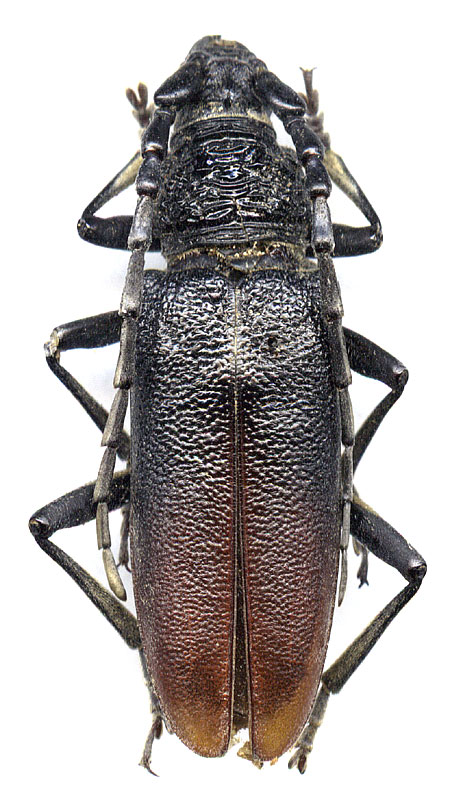
Fits the basic description: a dark colour bordering on purplish and 'short' horns. Prunus is indeed a foodstuff for its larva (though in Malta it generally lives in pear trees, according to Flora u Fawna).
So that basically gives an indication of specific pesticides you might use.
Those 38 species of Cerambycidae are not all the pests you might think as the majority are usually smaller, more host-specific and therefore rarer. In actuality I think the red palm weevil introduced more recently is far, far more threatening to our ornamental tree population than all the longhorns combined, though in cases like yours it is indeed a great pity to see the lovely almond trees succumbing. Hopefully it will not be too late to save them.
Girdling around a main trunk kills off trees immediately as it does away with all their phloem tissue, starving the roots. There is no other way around it, sadly, you might as well just cut the affected tree down before mature beetles start pouring out of it.
As for the males, Cerambyx nodulosus has longer antennae than Cerambyx carinatus, the former more than its body length, the latter basically the same.
This is what the female C. nodulosus looks like:
Fits the basic description: a dark colour bordering on purplish and 'short' horns. Prunus is indeed a foodstuff for its larva (though in Malta it generally lives in pear trees, according to Flora u Fawna).
So that basically gives an indication of specific pesticides you might use.
Those 38 species of Cerambycidae are not all the pests you might think as the majority are usually smaller, more host-specific and therefore rarer. In actuality I think the red palm weevil introduced more recently is far, far more threatening to our ornamental tree population than all the longhorns combined, though in cases like yours it is indeed a great pity to see the lovely almond trees succumbing. Hopefully it will not be too late to save them.
Girdling around a main trunk kills off trees immediately as it does away with all their phloem tissue, starving the roots. There is no other way around it, sadly, you might as well just cut the affected tree down before mature beetles start pouring out of it.
Here is the result of the photoshoot. Comparing with what is on the .cz site, it is really quite impossible to ID exactly, I can not discern differences. Carinatus is a good candidate, as good as any really.
RB
RB
- Attachments
-
- IMG_3561 (Medium).JPG (32.56 KiB) Viewed 45771 times
-
- IMG_3538 (Medium).JPG (31.23 KiB) Viewed 45771 times
Agreed, both carinatus and nodulosus seem very likely. but at least you got it narrowed down to a genus 
I've seen some of these on Prunus at Rabat, but that was quite some time ago and I do not recall if they had the same metallic tinge as these, furthermore they were covered in sawdust making it more difficult to discern.
I've seen some of these on Prunus at Rabat, but that was quite some time ago and I do not recall if they had the same metallic tinge as these, furthermore they were covered in sawdust making it more difficult to discern.