Water Figwort


Warning: getimagesize(Pics/SCRAU/SCRAU-_t.jpg) [function.getimagesize]: failed to open stream: No such file or directory in /home/marzmif4/public_html/WildPlants/!incl/mwp_functions.php on line 96
 / Water Figwort / Fiswet il-kelb tal-ilma
This plant is brought to you by one of the project's sponsors:
HSBC Cares for the Environment Fund
More sponsors are needed for this project [ click here ]

Contents Links


Nomenclature

Botanical Data

Description

General Information

Photo Gallery

Further Info & Links

Buy Seeds and Docs

Submit own info
about this plant

Give a small Donation Online

FORUM

Copyright Info


Main Index

 
Visitor hits ( -)

Nomenclature

Species name:


Author(s):

;
   

General names:

Maltese name:

Plant Family:

  (Figwort Family)

Name Derivation:

= Named in 1474 by an Italian physician who noticed the resemblance between the rhizomal knobs of some species and the tubercular condition of human lymph nodes called scrophula. Scrofula is a form of tuberculosis affecting the lymph nodes, especially of the neck, that is most common in children and is usually spread by unpasteurized milk from infected cows.
= Ear shaped, referring to the rounded lobes of the upper petals of the corolla. (Latin)

Synonyms:

No Main Synonyms

Remarks:

.


Botanical Data

PLANT STRUCTURE:

Characteristic

Growth Form

Branching

Surface

Description

Erect :

Upright, vertically straight up well clear off the ground.

Moderately Branched :

Considerable number of secondary branches along the main stem.

Glabrous to Puberulous:

Smooth; without any hairs, bristles or other projections. Some specimen have sparse minute hairs.

General
Picture

Wild Plants of the Mediterranean Islands of Malta  - Copyright Stephen Mifsud / Maltawildplants.com / Malta (2002-2007) Wild Plants of the Mediterranean Islands of Malta  - Copyright Stephen Mifsud / Maltawildplants.com / Malta (2002-2007) Wild Plants of the Mediterranean Islands of Malta  - Copyright Stephen Mifsud / Maltawildplants.com / Malta (2002-2007)

LEAVES:

Characteristic

Arrangement

Attachment

Venation

Description

Opposite :

Leaves that are situated in pairs at each node along the stem.

Stalked / Petiolate :

Hanging out by a slender leaf-stalk.

Pinnate / branched :

Veins that run at opposite sides of the common mid-vein and sub-branch towards the outer parts of the leaf.

General
Picture

Wild Plants of the Mediterranean Islands of Malta  - Copyright Stephen Mifsud / Maltawildplants.com / Malta (2002-2007) Wild Plants of the Mediterranean Islands of Malta  - Copyright Stephen Mifsud / Maltawildplants.com / Malta (2002-2007) Wild Plants of the Mediterranean Islands of Malta  - Copyright Stephen Mifsud / Maltawildplants.com / Malta (2002-2007)
 

Characteristic

Leaf Shape

Leaf Margin

Remarks

Description

Lanceolate to Ovate:

Lance shaped, widest in the basal third, tapering gradually towards the tip. Sometimes leaves tend to have a rather oval shape.

Crenate or Serrate:

Shallow, smooth and rounded teeth. Sometimes leaves have shallow serrate margin instead.

Stem

Stem is rectangular with the 4 corners extending out into short (1mm c.) wings.

General
Picture

Wild Plants of the Mediterranean Islands of Malta  - Copyright Stephen Mifsud / Maltawildplants.com / Malta (2002-2007) Wild Plants of the Mediterranean Islands of Malta  - Copyright Stephen Mifsud / Maltawildplants.com / Malta (2002-2007) Wild Plants of the Mediterranean Islands of Malta  - Copyright Stephen Mifsud / Maltawildplants.com / Malta (2002-2007)

FLOWERS:

Characteristic

Colour

Basic Flower Type

No. of Petals

No. of Sepals

Description

Dark red

Inflated Tubular Shape :

A flower in which the petals are fused into an almost enclosed globe or urn shape, separating at the mouth into individual flared petals or small teeth-like flaps. Mouth of the tube is not constricting.

5

Fused at more than half of their length into a tubular globose (helmet-like) structure.

5

Fused at about their basal third of their length. Margin scarious.

General
Picture

  Wild Plants of the Mediterranean Islands of Malta  - Copyright Stephen Mifsud / Maltawildplants.com / Malta (2002-2007) Wild Plants of the Mediterranean Islands of Malta  - Copyright Stephen Mifsud / Maltawildplants.com / Malta (2002-2007) Wild Plants of the Mediterranean Islands of Malta  - Copyright Stephen Mifsud / Maltawildplants.com / Malta (2002-2007)
 

Characteristic

Inflorescence

Description

Ovary

Stamens

Description

Panicle :

Elongate inflorescence with compound branching forming clusters of flowers. The inflorescence can be also described as group of simple cymes which collectively forms a pannicle-like arrangement.

The flower is made up of 5 petals most of their length fused into a spherical tube and the upper part free as rounded lobes. The mouth of the corolla is wide and without a constricting neck, sometimes described as helmet-shaped.

Inferior :

Ovary situated below the flower parts (the calyx, corolla, and androecium). In other words, these are attached above the ovary.

4, Didynamous :

Having one pair of stamen longer than the other pair. Often the stamens of the pair are very close to each other and seems to be fused as a single unit (connate).

General
Picture

Wild Plants of the Mediterranean Islands of Malta  - Copyright Stephen Mifsud / Maltawildplants.com / Malta (2002-2007) Wild Plants of the Mediterranean Islands of Malta  - Copyright Stephen Mifsud / Maltawildplants.com / Malta (2002-2007) Wild Plants of the Mediterranean Islands of Malta  - Copyright Stephen Mifsud / Maltawildplants.com / Malta (2002-2007) Wild Plants of the Mediterranean Islands of Malta  - Copyright Stephen Mifsud / Maltawildplants.com / Malta (2002-2007)
 

Characteristic

Scent

Average Flower Size

Pollen Colour

Other Notes

Description

None or mildly unpleasant

8mm x 5mm

Length of tube (including upper lobes) x diameter of tube.

Pale Yellow

Staminode

Apart from the 4 fertile stamens at the lower part of the corolla, there is an extra dark brown, sterile stamen called staminode located just below the upper lips.


SEEDS:

Characteristic

No. Per Fruit

Shape

Size

Colour

Description

More than 100

Small rounded bodies

Less than 1mm

Dark Brown

General
Picture

Wild Plants of the Mediterranean Islands of Malta  - Copyright Stephen Mifsud / Maltawildplants.com / Malta (2002-2007) Wild Plants of the Mediterranean Islands of Malta  - Copyright Stephen Mifsud / Maltawildplants.com / Malta (2002-2007) Wild Plants of the Mediterranean Islands of Malta  - Copyright Stephen Mifsud / Maltawildplants.com / Malta (2002-2007) Wild Plants of the Mediterranean Islands of Malta  - Copyright Stephen Mifsud / Maltawildplants.com / Malta (2002-2007)

FRUIT AND OTHER BOTANICAL DATA:

Characteristic

Fruit Type

Colour of Fruit

Subterranean Parts

Other Notes

Description

Dehiscent Loculicidal Capsule :

A fruit capsule that splits open longitudinally into the cavity of the locule when the seeds are ripe.

Green

(Pale brown when mature).

Rhizome :

A prostrate or underground plant stem, forming shoots above and roots below.They serve as a reproductive structure and sometimes have thickened areas that store starch. Rhizome is not nodular like many species of Scrophularia.

Plant Scent

The plant gives of a rather foetid smell, somehow similar to Ballota nigra.

General
Picture

Wild Plants of the Mediterranean Islands of Malta  - Copyright Stephen Mifsud / Maltawildplants.com / Malta (2002-2007) Wild Plants of the Mediterranean Islands of Malta  - Copyright Stephen Mifsud / Maltawildplants.com / Malta (2002-2007) Wild Plants of the Mediterranean Islands of Malta  - Copyright Stephen Mifsud / Maltawildplants.com / Malta (2002-2007) Wild Plants of the Mediterranean Islands of Malta  - Copyright Stephen Mifsud / Maltawildplants.com / Malta (2002-2007)

Plant Description

Life Cycle:

Habitat:

Frequency:

Undetermined

Sources in Malta:

Plant Height:

Flowering Time:

-

Poison:

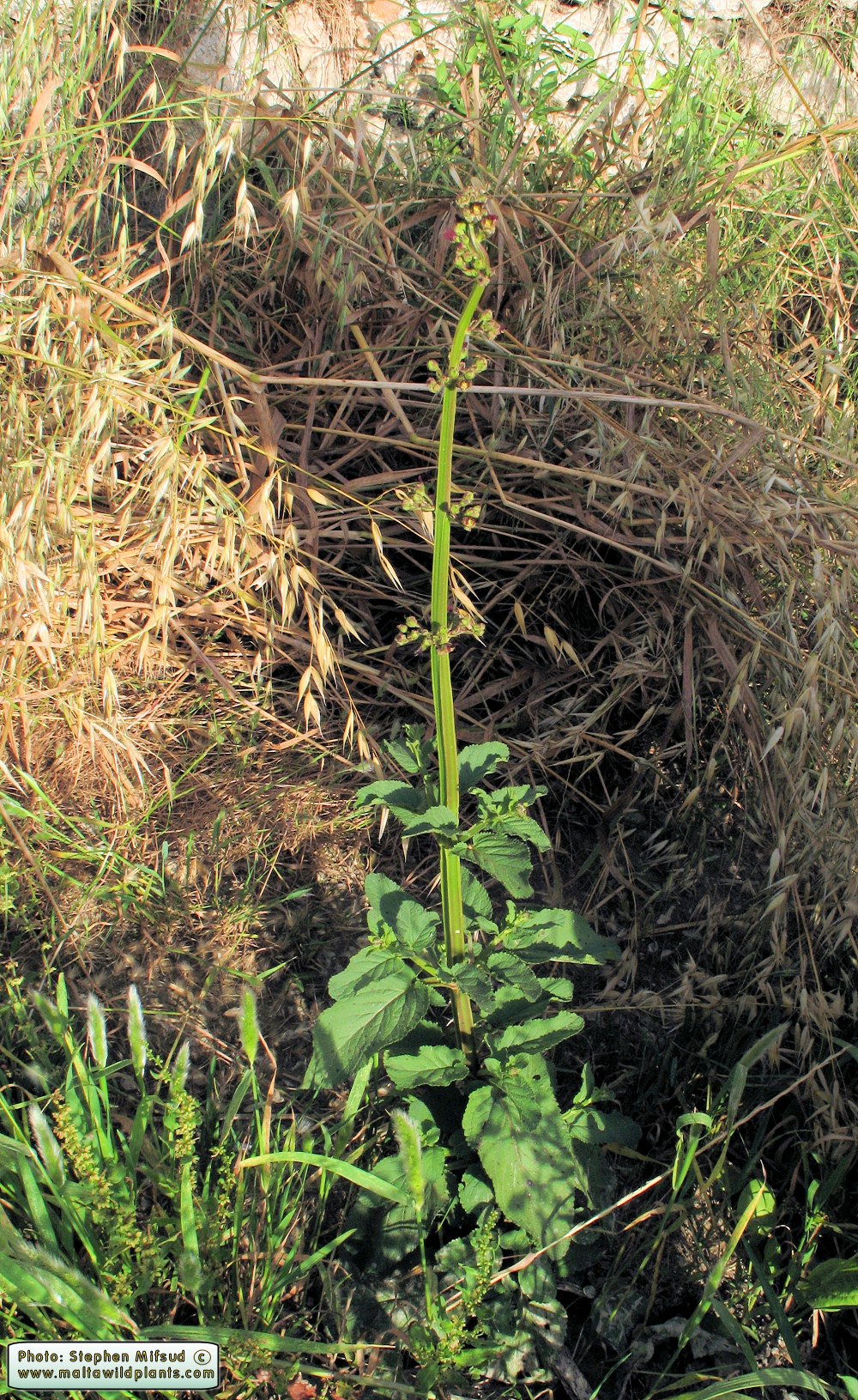
This herbaceous, mildly foetid plant is found in damp places or often beside water courses. It is perennial thanks to its underground, non-nodular rhizomes which are able to survive hot and arid summer climates. The plant forms numerous fibrous large roots.

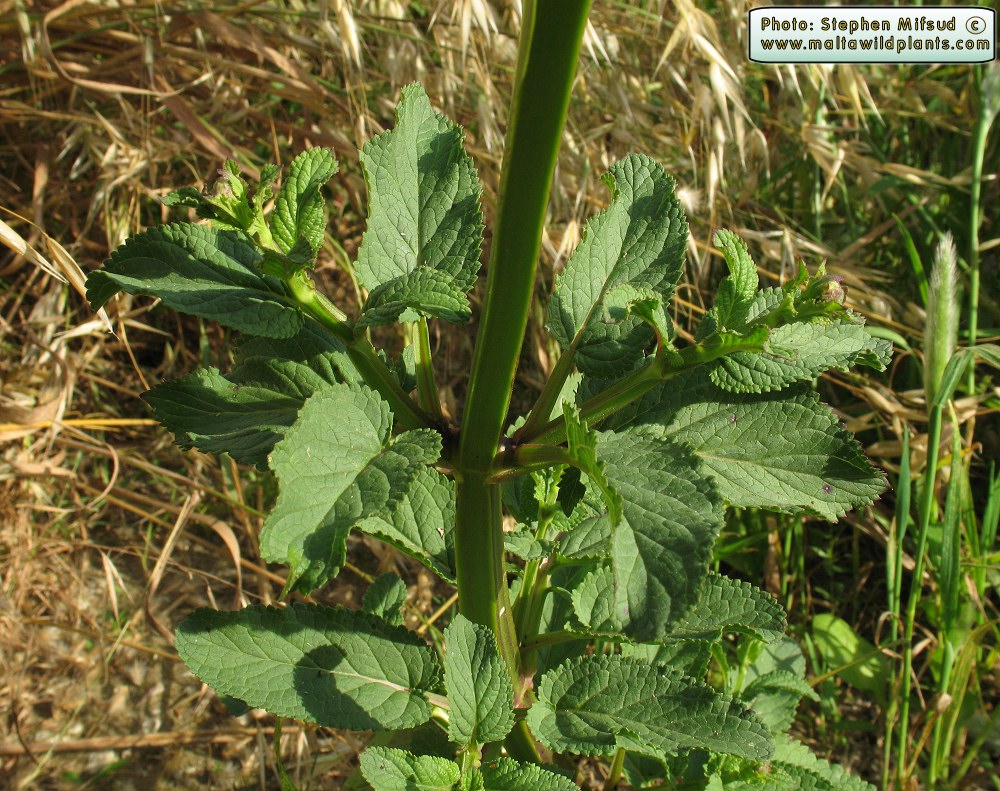
The green (or reddish,) glabrous to scarcely puberuluos, hollowed stem grows between 50 up to 150cm high. It has a four-angled cross section, with the corners stretching out into a wing or flap running along the whole length of the stem.

The glabrous, petiolated leaves are lanceolate (sometimes oval) in shape with a rather truncate base and blunt tip. They are arranged opposite along the stems, and often new sub-branches or inflorescences are formed from their axils. They have a crenate to shallowly serrate margin, and branched pinnate venation. Basal leaves can grow around 18cm long or more (including the petiole).

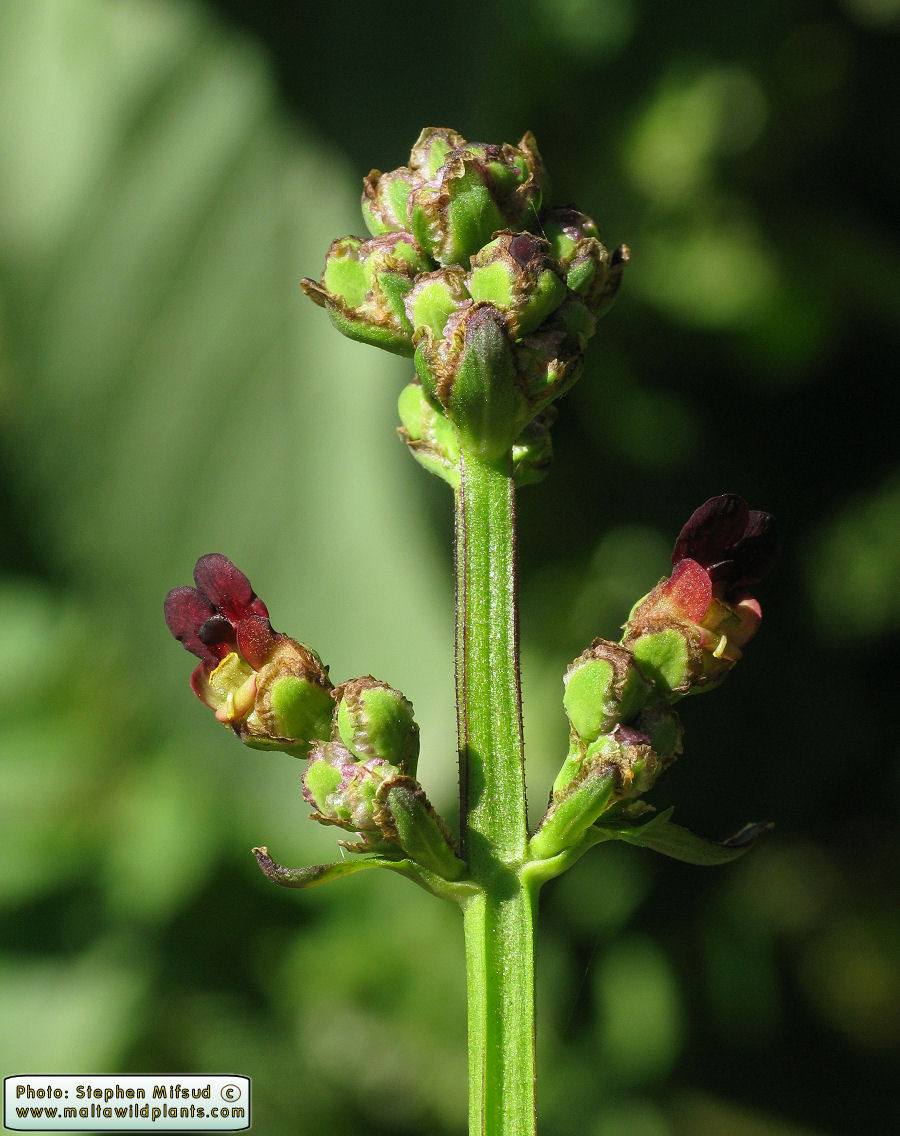
 (Water Figwort). Corolla of Scrophularia auriculataThe flowers are arranged in groups of few-flowered, simple cymes which collectively can be defined as a pannicle. Flowers have short pedicels with glandular hairs. The light green, actinomorphic calyx is composed of 5, short (3mm) rounded sepals, fused at their basal third. The zygomorphic corolla is made up of 5 petals which most of their lenght is fused together to form a spherical tube, and their upper part is free into small rounded lobes. The upper pair of lobes are erect, rounded and distinctly larger from the others being like a pair of 'ears' hence the epithet 'auriculata'. These have a contrasting dark-red to wine colour. The 2 lateral lobes are erect small, and the lower lobe is the smallest, green (or yellow) and curved back. The flowers produce very sweet, viscous nectar in abundant quantities at the base of the petals.

The reproductive part of the flowers consists of 4 stamens more or less of equal length and joined at the base of the lateral and lower petals. Each stamen is composed of a robust hairy filament and a pale, swollen, fertile anther. There is another sterile stamen (staminode) fused at the base of the upper petal which is red in colour with a swollen bifid apex. The pistil is mad of a green, rounded ovary and thin and rather inconspicuous style and stigma, often protruding out from the corolla by few mm.

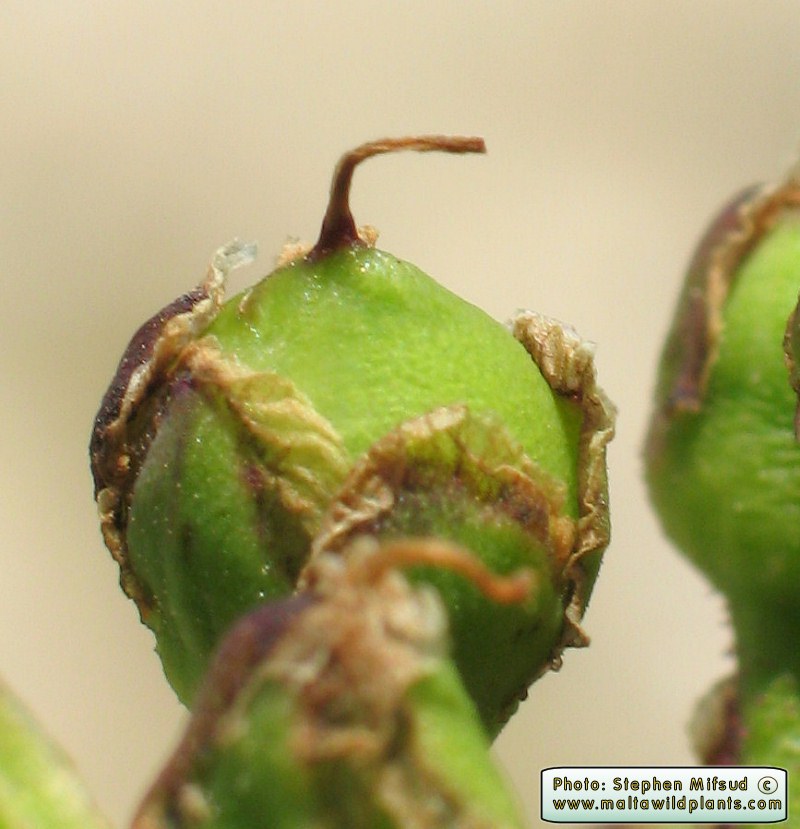
The fruit is a green, dehiscent capsule, about 1cm across, which when ripe, it turns brown and splits open into 2 valves. It holds numerous tiny, brown seeds (less than 1 mm in size) which escapes from the open fruit by the swaying of the tall plant. Seed dispersion is further aided by insects and possibly carriage by water streams.


Additional Information


Nativity and distribution

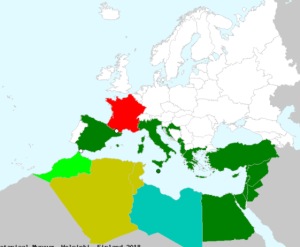
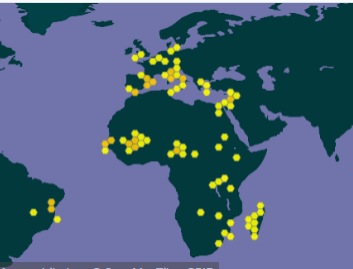
The distributional range of this plant is shown in the list below:  [WWW-26]

Northern Africa:   Algeria (n.), Morocco, Tunisia
Europe:   Portugal - Azores, Canary Islands, Ireland, United Kingdom, Belgium, Germany, Netherlands, Switzerland, Greece - Crete, Italy (incl. Sardinia, Sicily), Crete, Italy (incl. Sardinia & Sicily), Spain (incl. Baleares)


Reference  [WWW-158] states that S. auriculata is present in the following European countries:
Azores, Belgium and Luxemberg, Balearic Islands, Britain, Corsica, Crete, France, Germany, Ireland, Switzerland, Holland, Spain, Italy, Portugal, Sardinia, Sicily.

Propagation

Sow seeds in spring or autumn in a cold frame  [238] . When they are large enough to handle, prick the seedlings out into individual pots and plant them out in the summer.

If you have sufficient seed then it can be sown outdoors in situ in the autumn or the spring.  [KF]

Division in spring. Larger divisions can be planted out direct into their permanent positions. We have found it best to pot up the smaller divisions and grow them on in a lightly shaded position in a cold frame, planting them out once they are well established in the summer. Succeeds in most moist soils.  [KF]

Bee plant

Wasps and bees are very fond of the flowers, from which they collect much honey.  [WWW-03] It is also described as a good bee plant  [4] . At the base of each flower there is a viscous droplet of nectar  [SM]

Edible Uses

Reference  [2, 105] states that the root can be cooked and eaten, however,  [KF] doubts about the edibility of the root of this plant.

Medicinal Uses

The plant has the following medicinal properties according to reference:    [WWW-66] .
Anodyne Used to relieve pain.     [WWW-32]
Anti-cancer Used in the treatment of cancer; "anticancer drug"; "an antineoplastic effect".     [WWW-32]
Depurative An agent which is able of Purifying the blood or the humors (body fluids)     [WWW-32]
Detergent A medicine used to cleanse wounds, ulcers, etc.     [WWW-32]
Diuretic Tending to increase the secretion and discharge of urine.     [WWW-32]
Anti-inflammatory An agent that reduces or counteracts inflammation     [WWW-32]
Narcotic Causes dulling of consciousness, and hence induces sleep rapidly     [271]
Scrofula Acts against the disease called Scrofula - a constitutional disease, generally hereditary, especially manifested by chronic enlargement and cheesy degeneration of the lymphatic glands, particularly those of the neck, and marked by a tendency to the development of chronic intractable inflammations of the skin, mucous membrane, bones, joints, and other parts, and by a diminution in the power of resistance to disease or injury and the capacity for recovery. Scrofula is now generally held to be tuberculous in character, and may develop into general or local tuberculosis (consumption).     [WWW-32]
Vulnerary Useful in healing wounds; adapted to the cure of external injuries;     [WWW-32]


The leaves of the plant have vulnerary and detergent properties and have been used in folk medicine as a poultice for ulcers, sores and wounds.  [WWW-27]

The leaves are detergent and vulnerary  [4] . They are harvested as the plant comes into flower and can be used fresh or dried for later use  [4] . The plant has a good reputation as a wound herb, either applied externally as a poultice or taken as a decoction  [4] .

Water betony is said to have similar medicinal properties to the knotted figwort, Scrophularia nodosa  [254] . These properties are as follows:- Knotted figwort is a plant that supports detoxification of the body and it may be used as a treatment for various kinds of skin disorders  [254] .

The whole plant is alterative, anodyne, anti-inflammatory, diuretic, mildly purgative and stimulant  [4, 9, 21, 165] .

It is harvested as the plant comes into flower in the summer and can be dried for later use  [4] .

A decoction is applied externally to sprains, swellings, burns, inflammations etc, and is said to be useful in treating chronic skin diseases, scrofulous sores and gangrene  [4, 254] . The leaves can also be applied fresh or be made into an ointment  [4] .

Internally, the plant is used in the treatment of chronic skin diseases (such as eczema, psoriasis and pruritis), mastitis, swollen lymph nodes and poor circulation  [238] .

It should not be prescribed for patients with heart conditions  [238] . The root is anthelmintic  [9] . This plant has vulnerary and detergent properties, and has enjoyed some fame as a vulnerary, both when used externally and when taken in decoction. In modern herbal medicine, the leaves are employed externally as a poultice, or boiled in lard as an ointment for ulcers, piles, scrofulous glands in the neck, sores and wounds. It is said to have been one of the ingredients in Count Matthei's noted remedy, 'AntiScrofuloso.'  [WWW-03]

In former days this herb was relied on for the cure of toothache and for expelling nightmare. It has also a reputation as a cosmetic, old herbalists telling us that: 'the juice or distilled water of the leaves is good for bruises, whether inward or outward, as also to bathe the face and hands spotted or blemished or discoloured by sun burning.'  [WWW-03]

Toxicity

Few sources on the internet mention that the plant is believed to bu toxid, without giving more details. One reference  [76] states that the plant is toxic to cows. Another source  [WWW-125] states that Scrophularia auriculata (also called water betony or Water Figwort) probably contain toxic cardiac glycosides; causes excitement, tachypnea, pupillary dilatation, oral mucosal congestion and ulceration, dysuria and profuse diarrhea.

Curiosities related to the names of the plant.

The Figwort is named in Somersetshire, 'Crowdy Kit' (the word kit meaning a fiddle), or 'Fiddlewood,' because if two of the stalks are rubbed together, they make a noise like the scraping of the bow on violin strings, owing no doubt to the winged angles. In Devonshire, also, the plant is known as 'Fiddler.'  [WWW-03]

The Water Figwort has obtained the name of Water Betony from a certain resemblance of its leaves to those of the Wood Betony, but it differs entirely from that plant in every other respect, not being even closely related to it, and nowadays is more generally called the Water Figwort, the name Figwort being derived from the form of the root in another member of the genus Scrophularia, the Knotted Figwort (S. nodosa), a fairly common plant.  [WWW-03]

Proposal to conserve the name Scrophularia auriculata (Scrophulariaceae) with a conserved type

Two of the moisture-loving Scrophularia species have been known as S. lyrata Willd. and S. auriculata L. The differences between the two taxa, which were assessed by Grau (in Mitt. Bot. Staatssamml. München 12: 622-627. 1976), and reiterated by Ortega-Olivencia & Devesa (in Ruizia 11: 52. 1993), are to be found above all in the morphology of leaves, bracts, bracteoles, and staminode. The former, S. lyrata, includes plants which are often pubescent, with basal and medial leaves clearly lyrate, having 2–6 lateral lobules; bracts and bracteoles normally obovate and obtuse, with a broad, undulate, generally dark-purple scarious margin; and staminode orbicular or obovate (never more broad than long). It possesses 2n = 58 chromosomes, and is distributed through the Iberian Peninsula, Sardinia, Sicily, Crete, Morocco, and Algeria. The latter, S. auriculata, includes plants which are often glabrescent, with basal and medial leaves that are generally simple or with 1–2 basal lobules; bracts and bracteoles generally lanceolate and acute, with a narrow scarious margin frequently relegated to the apex, barely or not at all undulate, normally hyaline or greyish-brown; and staminode generally broader than long, subreniform or flabellate. It possesses 2n = 84 chromosomes, and is present in W and SW Europe, Corsica, Italy, and Morocco.  [403]

A New Iridoid from Scrophularia auriculata ssp. pseudoauriculata

A new iridoid glycoside, scrovalentinoside (1), was isolated from the MeOH extract of the aerial parts of Scrophularia auriculata L. ssp. pseudoauriculata. The structure of the new compound 1 was elucidated as 6-O-(2'',3''-di-O-acetyl-4''-O-p-methoxy-cinnamoyl)--L-rhamnopyranosyl catalpol by spectroscopic methods. The known iridoid glycoside, scropolioside A; two saponins, verbascosaponin A and verbascosaponin; and the phenylethanoid glycoside, verbascoside, were also isolated.  [400]

Anti-inflammatory glycoterpenoids from Scrophularia auriculata

The activity of the four glycoterpenoids: two saponins, verbascosaponin A and verbascosaponin, and two iridoids, scropolioside A and scrovalentinoside, isolated from Scrophularia auriculata ssp. pseudoauriculata, were studied in different models of acute and chronic inflammation. Both saponins significantly inhibited the mouse paw edema induced by carrageenan and ear edema induced by single and multiple doses of 12-O-tetradecanoylphorbol 13-acetate (TPA). Verbascosaponin A showed a potency twice as high as that of indomethacin in the acute TPA model. Verbascosaponin A and scropolioside A were active after a long latency period against ethyl phenylpropiolate edema, as are glucocorticoids. When the putative corticoid-like mechanism of the two compounds was studied, verbascosaponin A activity was notably reduced by the mRNA synthesis inhibitor, actinomycin D, while the effect of scropolioside A was partially interfered with by the anti-glucocorticoid drugs used. Both iridoids were active on the delayed type hypersensitivity reaction. They significantly reduced the inflammatory lesion and suppressed the cellular infiltration.  [401]

Closely Related species

Another damp-loving Scrophularia species which resembles Scrophularia auriculata L. is Scrophularia lyrata Willd., a species that it is not recorded on the Maltese Islands. On contrast to S. auriculata, S. lyrata is pubescent, has more compound leaves that is lyrate with 2-6 lobes each, more obtuse bracts (obovate shape) with undulate margins, and an orbicular or obovate staminode which is never more broad than long.  [403]

Personal Observations


Closely Related species in Malta
The much more common Scrophularia peregrina, is often found in arable land or wasteground beside arable land, but seldom in damp habitats. It can be distinguished from S. auriculata by being smaller, having unwinged stems and non scarious sepals. S. auriculata is a very rare plant, possibly facing extintion due to loss of habitat and so one should not damage, cut or tamper with this plant.  [SM]

Photo Gallery

 (Water Figwort) - CLICK TO ENLARGE PHOTO  (Water Figwort) - CLICK TO ENLARGE PHOTO  (Water Figwort) - CLICK TO ENLARGE PHOTO  (Water Figwort) - CLICK TO ENLARGE PHOTO
Photo of the zygomorphic flower having a dark red / wine colour at the upper part, and pale green or cream at lower part.
Photo of two flowers. The mouth of the corolla tube is rather wide; not constricting to a narrow neck. The reproductive organs are hence well accessible by pollinators of different sizes.
Close-up photo of a flower against background illumination showing the solitary staminode at the roof of the corolla, and the fertile stamens and green style at the lower part.
Close up photo of the pedicels of the flowers, revealing numerous glandular hairs.
 (Water Figwort) - CLICK TO ENLARGE PHOTO  (Water Figwort) - CLICK TO ENLARGE PHOTO  (Water Figwort) - CLICK TO ENLARGE PHOTO  (Water Figwort) - CLICK TO ENLARGE PHOTO
Photo of the upper part of the flower. It has 2 large, rounded lobes which resembles a pair of ears, hence the species name 'auriculata' (= ears).
Photo showing the mouth of the flower. The flower is composed of 5 petals which are fused together to form a spherical tube. The apical part of the petals are free as small lobes, of which the upper pair are the largest, and the lower one the smallest.
Another photo showing a close up of the flower mouth, with the reproductive organs inside. The yellow stamens have thick filaments.
Photo of the flower and the fruit - a green rounded capsule.
 (Water Figwort) - CLICK TO ENLARGE PHOTO  (Water Figwort) - CLICK TO ENLARGE PHOTO    (Water Figwort) - CLICK TO ENLARGE PHOTO
Close up photo of the flower showing the cushion-like anthers and the globular stigma covered with short sticky hairs.
Close up photo showing the lower part of the flower. The lower lip or petal lobe is the smallest, and folded perpendicularly downwards.
-
Photo of the inflorescence, rather atypical in this specimen since they are rather compact where usually they are more lax with long pedicels.
     (Water Figwort) - CLICK TO ENLARGE PHOTO  (Water Figwort) - CLICK TO ENLARGE PHOTO
-
-
Scanned image of a flower which is dissected longitudinally along the vertical plane to show the internal reproductive parts. The stamens are attached at the lower part of the corolla tube.
Scanned and annotated image of a flower which is dissected longitudinally along the horizontal plane showing the internal reproductive parts. Note that there is the fertile stamens at the lower part and the sterile staminode at the upper part.
 (Water Figwort) - CLICK TO ENLARGE PHOTO  (Water Figwort) - CLICK TO ENLARGE PHOTO  (Water Figwort) - CLICK TO ENLARGE PHOTO  (Water Figwort) - CLICK TO ENLARGE PHOTO
Photo of leaves in situ. They are petiolated and arranged in opposite directions along the stem.
Photo of leaves having prominent, pinnately-branched, sunken venation.
Scanned image of a typical cauline leaf - lance-shaped with a truncated base, a crenated to shallow-serrated margin,and fairly long petiole.
Scanned image of upper leaves.
 (Water Figwort) - CLICK TO ENLARGE PHOTO  (Water Figwort) - CLICK TO ENLARGE PHOTO  (Water Figwort) - CLICK TO ENLARGE PHOTO  
Photo of the perennial plant which grows around 50-60cm, but can reach up to 1m.
Photo of the rectangular stem with pronounced wings at the corners.
Photo of a young fruit capsule. When mature it turns brown and the tiny seeds are released by the swaying of the plant, which might be further dispersed by ants or water streams.
-

Further Information and Links

Proposal to conserve the name Scrophularia auriculata (Scrophulariaceae) with a conserved type. (Ortega-Olivencia A. ; Devesa J. A.) Effects of Natural Products on Contact Dermatitis / J.L. Ríos*, E. Bas and M.C. Recio
Profile from floralimages.co.uk Profile from UK Wild Flowers


Buy from and support MaltaWildPlants.com

Buy Seeds from Maltawildplants.com Buy samples of seeds of certain wild plants for your studies, trials, research, etc. Not all species' seeds can be exported (depending on Maltese regulations), and availability depends on season of species. So, before any payment, you are kindly asked to fill in the online quotation/order form by which I can contact you back for availability and charges. Buy Seeds from Maltawildplants.com   Online Quotation

Buy Seeds from Maltawildplants.com   Online Payment
Buy Documents from Maltawildplants.com Buy documents related to Maltese Wild Plants such as the list of references, full profile, or other docs you request. Buy Documents from Maltawildplants.com   Online Payment
Buy Images  from Maltawildplants.com Buy any of my own copyright images found in this large collection of Maltese flora. You should first select the image you want to buy and input its corresponding code (found beneath each individual photo) in the online ordering form. Buy Seeds from Maltawildplants.com   Online Payment
Buy Seeds from Maltawildplants.com Kindly donate any sum of money (from 2USD / 2Euro) to help us covering some expenses needed to maintain Maltawildplants.com. Please bear in mind how much hard work such a large and up-to-date website needs to arrive directly to you home, office or library. Your kind donations are both greatly appreciated and recorded for future reference. Donors asking help will have first que preference for assistance and special attention. Buy Seeds from Maltawildplants.com   Online Donation


Submit More Information

Use the form below to submit more information about this plant or a related species. If the data is taken from a book, journal, website, etc, please provide the corresponding reference / website address as indicated in the form. If it is your own observation, then your name will be cited. Your Email address will never be displayed online, it is just for internal communication.


For plant species that are marked as rare, you can also report other locations in Malta where you have seen this species.

Finally you can report any mistakes or errors found on the plant profile for necessary corrections. This will help to improve the website's acuracy.


To have more details about each particular field, just move your mouse on it and wait for the help message to pop up

* = required fields.
Plant Species:  *
Your name:   *
Your Email:   *
Fill any of the following 3 sections below (A, B or/and C) and send the form. - Thank you.
 
A:  Additional Information about this plant species
Own observations:
Info from published material (books, jounals, website):

Reference of published material:

 
B:   Where have you seen this plant on the Maltese Islands?
Locations in Malta or Gozo where you have encountered this plant.
Mostly applies for rare plants.


1:        2:   
3:       4:   
5:       6:   

Try to be as concise as possible. Examples: Dingli Cliffs (near chapel), Wied Incita (Zebbug side), Triq il-Kbira (Qormi), Barriera ta\' Abdul (Xlendi), Fields near Salib tal-gholja (Siggiewi). GPS bearings are also welcomed!
 
C:  Corrections for mistakes and errors in this plant profile.
Section of this plant Profile page where you found an error (select one)

What is the error/mistake
What should be its correction


All material and data on this webpage is under the copyright of the author of this site - Stephen Mifsud / www.MaltaWildPlants.com / Malta. (2002-2008)
This research project about the flora of Malta is sponsored by:
Middlesea Insurance p.l.c. A Fund established to help in the amelioration and enhancement of the environment in Malta and to take initiatives that enhance awareness on environmental issues amongst the public Empty space for sponsor Empty space for sponsor Benefit companies get by sponsoring this project