Peppermint

Mentha pulegium , Peppermint

Contents Links


Nomenclature

Description

Further Info & Links

Buy Seeds and Docs

Submit own info
about this plant

Give a small Donation Online

FORUM

Copyright Info

Funds are needed for a full profile of this plant


Main Index

 
Visitor hits (Oct/06)

Nomenclature

Species name:

Mentha pulegium   L.

Author(s):

Carl von Linné
   Sweden, 1707-1778

General names:

Peppermint
European Pennroyal
Pennyroyal Mint

Maltese name:

Plejju

Plant Family:

Lamiaceae / Labiatae   (Mint Family)

Name Derivation:

Mentha = A name for an unfortunate Greek nymph named Mentha who got herself turned into a mint plant, and a genus of culinary herbs named after her, this is one of the oldest plant names still in use. (Latin);
pulegium = From the Latin word 'pulex', - a flea-repellant. (Latin).

Synonyms:

Pulegium vulgare, Melissa pulegium, Mentha aromatica, Mentha aucheri, Mentha daghestanica, Mentha gibraltarica, Mentha tomentella, Mentha tomentosa


Plant Description

Life Cycle:

Perennial

Habitat:

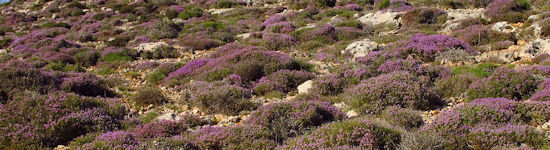
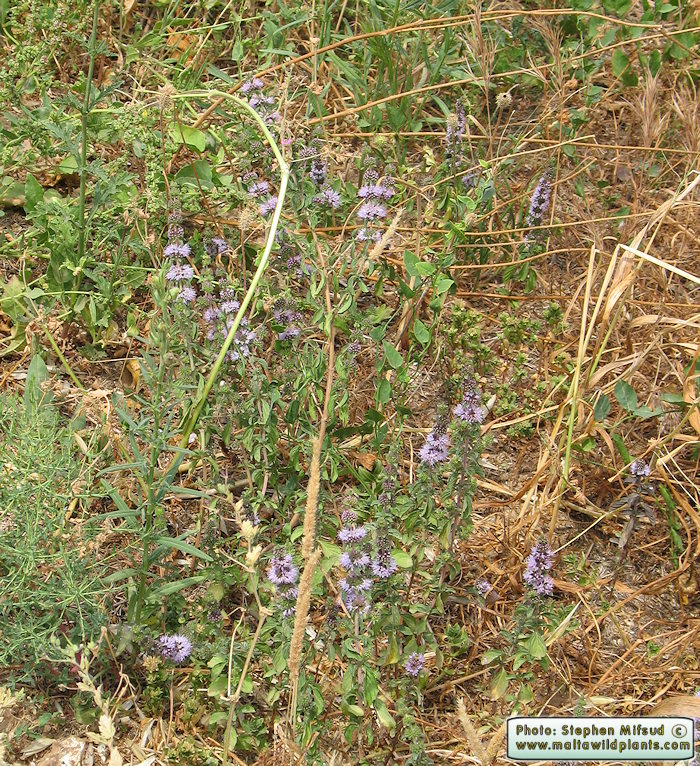
Valley bottoms, damp shaded places, cultivated or waste places near damns or water courses.

Sources in Malta:

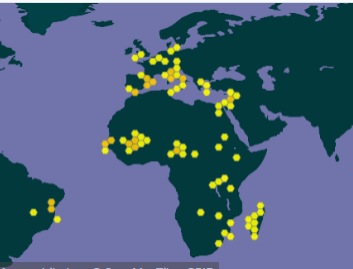
Frequent such as in Chadwick lakes, Wied Incita and Wied tal-Mistra.

Plant Height:

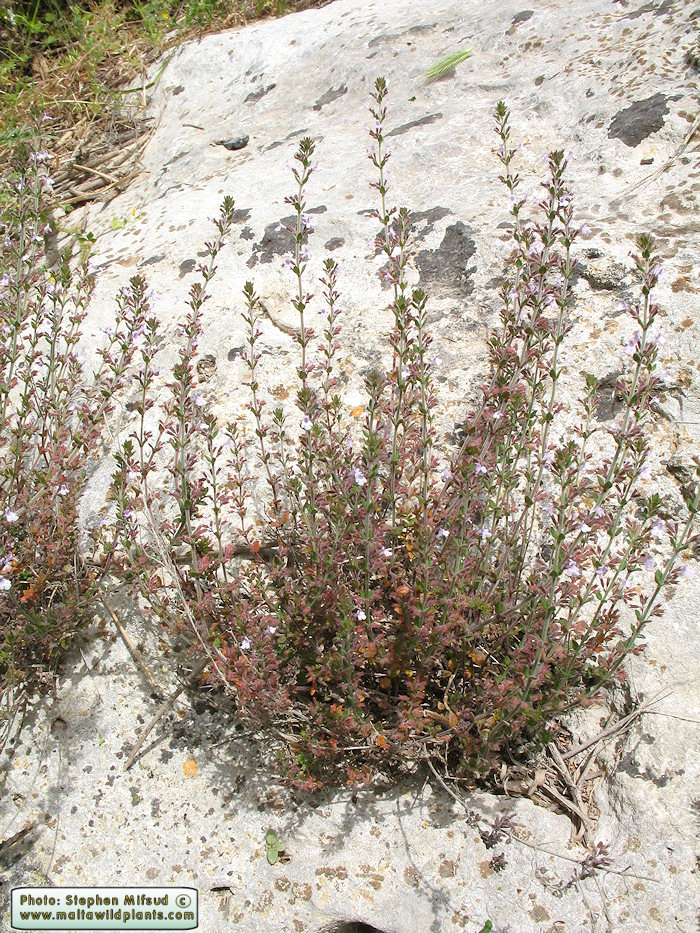
15-40cm long

Flowering Time:

Apr-Aug

An plant that has a particular and distinguishable peppermint-like odour (for some pungent, for others acceptable) that is given off especially during the flowering time; an odour typically present at several valley bottoms or water courses.

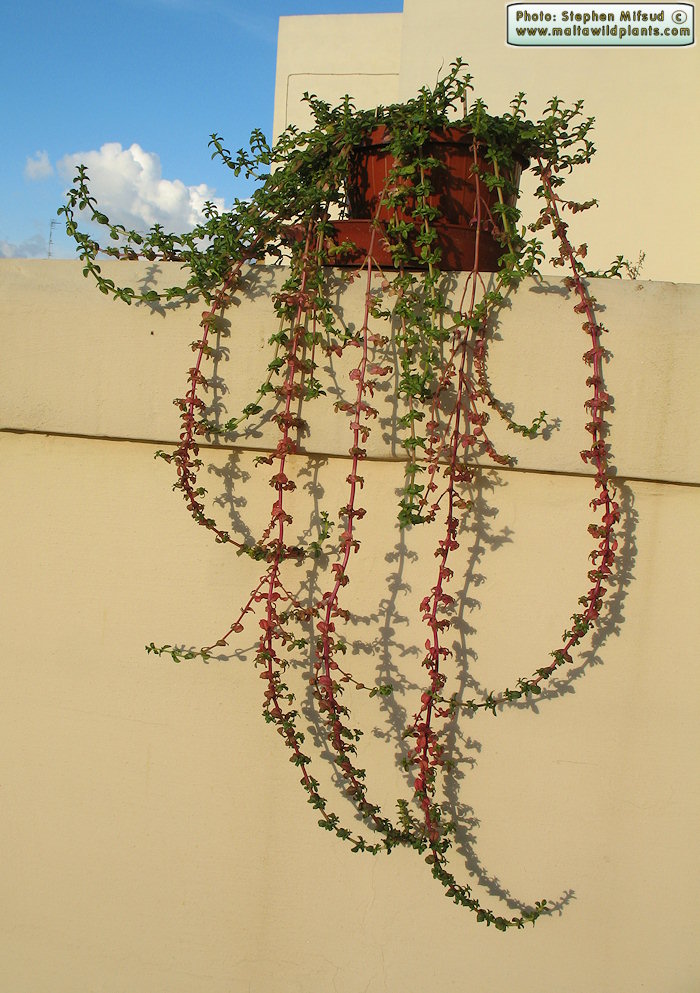
The plant is perennial thanks to the all-year living underground creeping rhizomes. It forms procumbent to ascending, hairy stems, with flowering stalks always being upright. In autumn, aerial rootlets are formed from stems lying on wet ground. When these roots establish in the soil, the new 'daughter plant' gets independent from the mother plant, hence giving rise to a form of asexual reproduction. This propagation method is common in several mint plants, including some cultivated spice herbs.

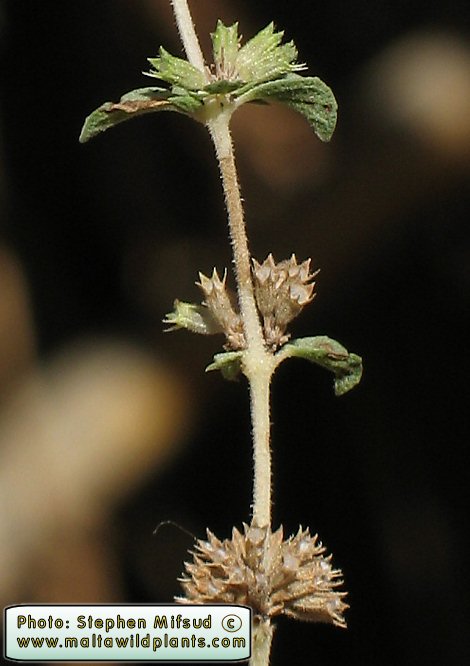
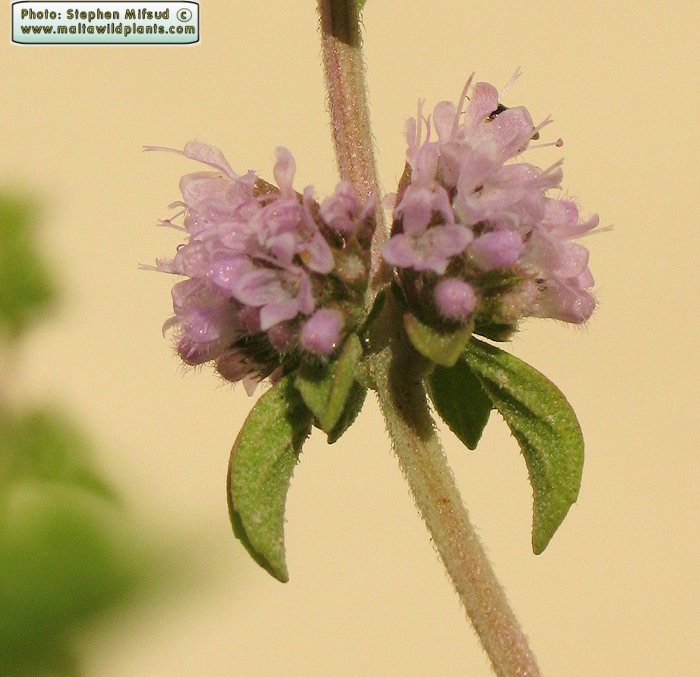
The leaves are found in opposite decussate pairs that are subsessile when young, and becomes shortly petiolated later on. They have oval or spindle shaped leaves, often with a smooth margin (sometimes with 3-6 small teeth on each edge). They are shortly and sparsely haired below. Bracts leaf-like but smaller.

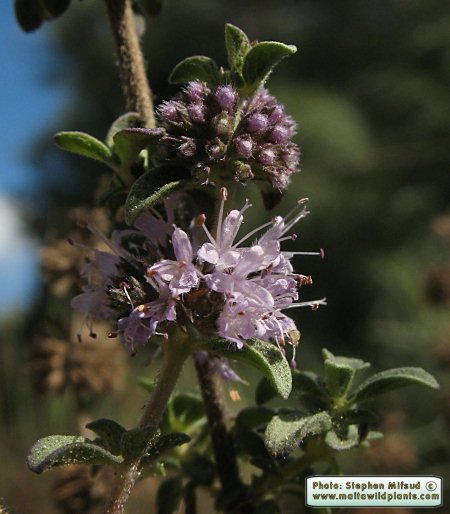
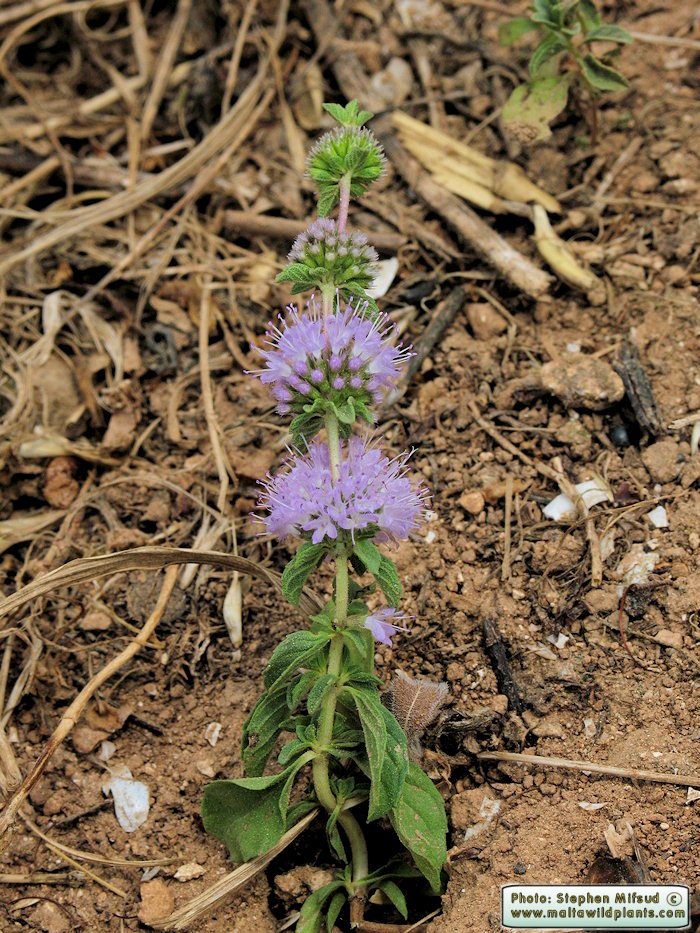
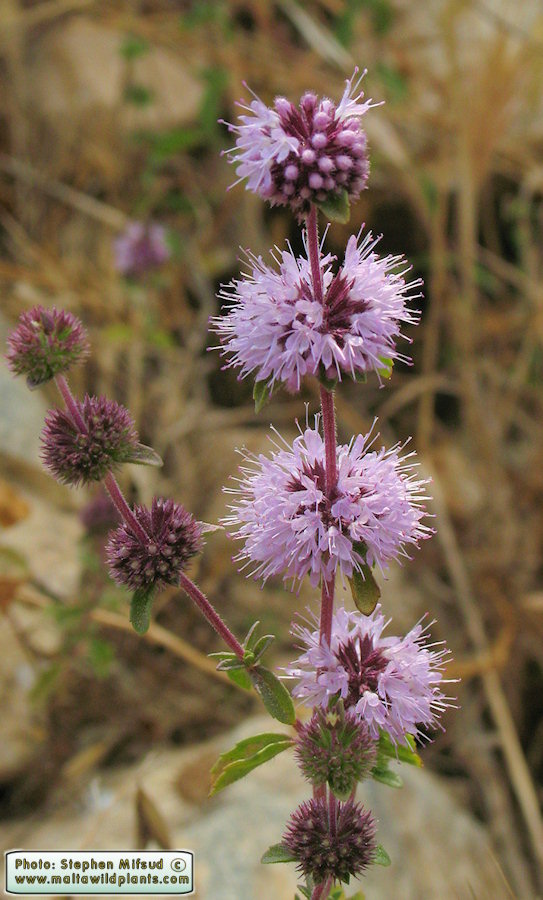
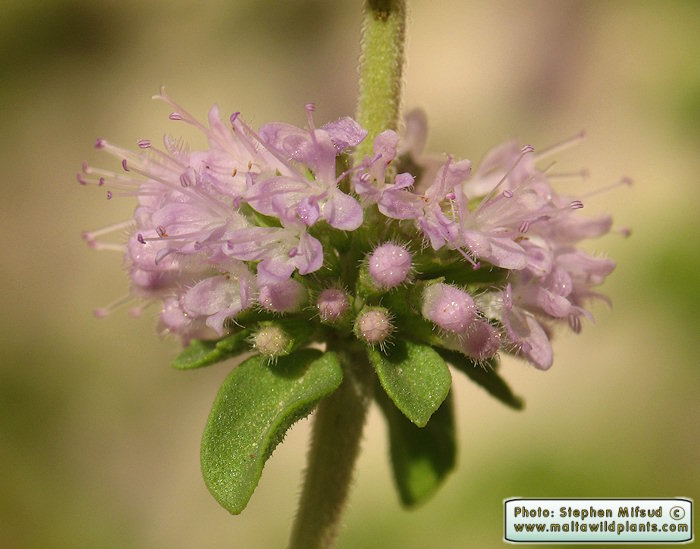
The inflorescence consists of a dense, multi-flowered verticillasters, forming a sub-spherical structure of radiating flowers around the flowering stalk. The inflorescence clusters are found spaced at regular intervals along the flowering stalk, with the lower cluster being slightly wider from the younger above. This forms an interesting flower stalk with several 'balls' of violet flower clusters gradually becoming smaller in size towards the tip.

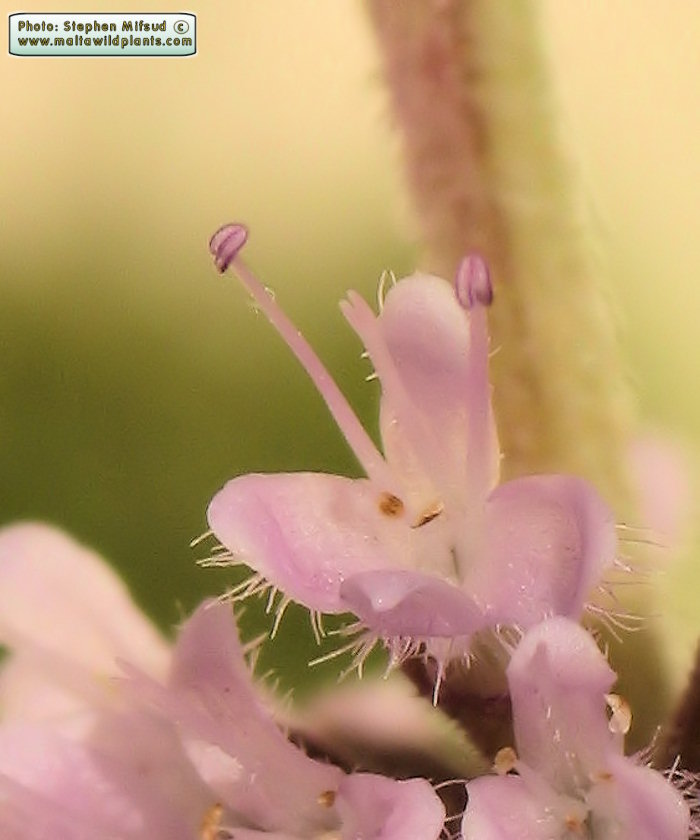
Mentha pulegium Each flower consists of a tubular, toothed calyx and a small, 2-lipped, violet-lilac corolla with a white throat (centre). The calyx is 2-3mm long, nearly actinomorphic and composed of 5 ciliated teeth, with the upper one being shorter and broader while the lower one is longer and narrower. The 5-6mm long corolla consists of 2 lips, with the lower one further subdivided into 3 lobes, each being identical to each other and to the upper lip, hence giving a general appearance that the corolla consists of 4 small petals rather than a 2-lipped morphology. Corolla tube shorter from calyx with lobes being conspicuously ciliated.

The flower's male reproductive organs consists of 4 stamens that are firm, divergent and protruding out from the corolla. They have thin, white filaments and small, lilac-purple anthers. The female part is a central pistil with a small ovary hidden at the base of the calyx and a white style as long as the stamens. Stigma divided into 2 parts with swollen tips.

The fruit is composed of 4, small ( < 1mm), brown nutlets sheltered inside the calyx, which when ripe, they become loose and fall off without any special means of dispersion.


Further Information and Links

Photos from Google Info Link 2
Info Link 3 Info Link 4


Buy from and support MaltaWildPlants.com

Buy Seeds from Maltawildplants.com Buy samples of seeds of certain wild plants for your studies, trials, research, etc. Not all species' seeds can be exported (depending on Maltese regulations), and availability depends on season of species. So, before any payment, you are kindly asked to fill in the online quotation/order form by which I can contact you back for availability and charges. Buy Seeds from Maltawildplants.com   Online Quotation

Buy Seeds from Maltawildplants.com   Online Payment
Buy Documents from Maltawildplants.com Buy documents related to Maltese Wild Plants such as the list of references, full profile, or other docs you request. Buy Documents from Maltawildplants.com   Online Payment
Buy Images  from Maltawildplants.com Buy any of my own copyright images found in this large collection of Maltese flora. You should first select the image you want to buy and input its corresponding code (found beneath each individual photo) in the online ordering form. Buy Seeds from Maltawildplants.com   Online Payment
Buy Seeds from Maltawildplants.com Kindly donate any sum of money (from 2USD / 2Euro) to help us covering some expenses needed to maintain Maltawildplants.com. Please bear in mind how much hard work such a large and up-to-date website needs to arrive directly to you home, office or library. Your kind donations are both greatly appreciated and recorded for future reference. Donors asking help will have first que preference for assistance and special attention. Buy Seeds from Maltawildplants.com   Online Donation


Submit More Information

Use the form below to submit more information about this plant or a related species. Later on, this info will be included in this plant profile. You are kindly asked to provide the reference(s) from which the written information is taken. If it is your own observation or reference, simply write how you wish to be cited. Otherwise input the book or website from where your information is taken.

Your Email address will never be displayed online, it is just for internal communication.

You can also report the location where you have seen this particular plant on the Maltese islands to have a more extensive floral map of our islands.

Finally you can report any corrections needed for erranous data found in any part of this plant profile. This will definitely help to make this resource become better and more accurate.
To have more details about each particular field, just move your mouse on it and wait for the help message to pop up

* = required fields.
Plant Species *
Your name *
Your Email *
Fill any of the following 3 sections below (A, B or/and C) and send the form. - Thank you.
 
A:  Additional Information about this plant species
Own observations
Your Reference:
Additional Info 1
Reference
Additional Info 2
Reference
 
B:   Where have you seen this plant on the Maltese Islands?
Locations in Malta or Gozo where you have encountered this plant.
Mostly applies for locally frequent to rare plants.

1:        2:   
3:       4:   
5:       6:   

Try to be as concise as possible. Examples: Dingli Cliffs (near chapel), Wied Incita (Zebbug side), Golden Bay, Triq il-Kbira (Qormi), Barriera ta' Abdul (Xlendi), Fields near salib tal-gholja (Siggiewi), Buskett (Verdala side), Chadwik Lakes (Fiddien side) and other such locations around Malta and Gozo. GPS readings are welcomed too! Thank you.
 
C:  Corrections for mistakes and errors in this plant profile.
Section of this plant Profile page where you found an error (select one)

What is the error/mistake
What should be its correction


All material and data on this webpage is under the copyright of the author of this site - Stephen Mifsud / www.MaltaWildPlants.com / Malta. (2002-2008)
This research project about the flora of Malta is sponsored by:
Middlesea Insurance p.l.c. The primary objective of The Strickland Foundation is to foster the national interest of Malta and in particular to promote in Malta democratic principles, the observance of human rights and the exercise of a free press.
A Fund established to help in the amelioration and enhancement of the environment in Malta and to take initiatives that enhance awareness on environmental issues amongst the public Empty space for sponsor Benefit companies get by sponsoring this project