| |
|
 | |
| MaltaWildPlants.com by Stephen Mifsud |
|
| |
|
|
 |  |  |  |
| External Links: |
|
Euphorbia terracina (Coastal Spurge) |

Euphorbia terracina (EUPHORBIACEAE.)
Images for this profile are taken from the Maltese Islands after year 2000. |
|
| Nomenclature and Basic Information |
Species name : |
Euphorbia terracinaL.
Published in Sp. Pl. ed. 2, 654 (1762) |
Synonyms :
(basionym or principal syn.) |
|
Plant Family : |
Euphorbiaceae
Juss. (The Spurge Family)
30 species from the Euphorbiaceae family are recorded from the Maltese Islands. | English name(s) : | Coastal Spurge, False Caper, Geraldton Carnation Weed |
Maltese name(s) : |
Tengħud tax-xatt |
Status for Malta : |
Indigenous. Present on the Maltese islands before man |
Frequency : |
Very Common Common Frequent Scarce Rare Very rare Extinct |
Growth form : |
Raunkiaer lifeform [info]: THEROPHYTE ( annual plants, herbaceous )
Germination [info]: Dicotyledon |
Legal Protection : |
Protected by law: Schedule III and VI of [S.L. 549.44] (strictly protected species) |
Red List (1989) : |
Threatened status for the Maltese Islands and has been listed in the Red Data Book (1st ed.) |
Flowering Time : |
April – August |
Colour of Flowers: |
Inconspicuous |
Toxicity: |
May cause allergic reactions or irritation in contact with the skin or mucous membranes |
Name Derivation : |
Euphorbia: Named for Euphorbus, a Greek physician to Juba II - King of Mauretania of Numibia (52-50 BC - 23 AD), who might have used a certain plant in allusion to his swollen belly, possibly the plant Euphorbia resinifera. (Further info: [link]). Euphorbus can have also been derived from 'Eu-' = good or true and '-phorbe' = pasture or fodder, thus giving the meaning well-fed or provides a fat-belly from consumption. (Greek origin )
terracina: Uncertain meaning, but possibly has a connection with a small Italian town called Terracina which hosts a large seaside resort area between Rome and Naples, and perhaps the first plants of this species were described from there. Further info: [1] [2]. (Latin origin )
|
Planting in rural areas : |
Can be planted in rural areas according to ERA Guidelines |
|
|
Description, Habitat and Distribution | |
Habitat in Europe: |
Dry sandy ground, often near the sea. | |
Preferred habitat in Malta: |
Confined to sandy seashores. | |
Botanical Description: |
Glabrous perennial; stem up to 70 cm, simple or branched from the base and with 0-5 axillary rays. Leaves 15-40(-55) x 4-7(-11) mm, linear-lanceolate to elliptic-oblong, rarely (var. angustifolia Lange) 1.5-2 mm wide, linear, minutely serrulate. Ray-leaves resembling the upper cauline. Raylet-leaves deltate-rhombic, sometimes slightly asymmetrical, occasionally coarsely serrulate. Rays 4-5, up to 5 times dichotomous. Glands with 2 long, slender horns. Capsule 3-5 x 4-5 mm, deeply sulcate, smooth. Seeds 2-2.5 mm, ovoid, pale grey. | |
Distributional range: |
Mediterranean region, extending to N.W. Spain and Portugal. |
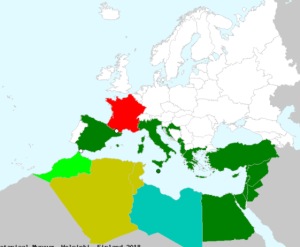
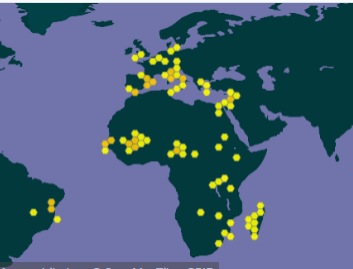
Distributional map in Europe
and the Mediterranean region (2018): |
|
Occurrences in Europe.
(from Flora Europaea pre year 1993): |
Albania, the Balaeric Islands, Corse, Crete, France (incl. Monaco and Channel Islands but excluding Corse), Greece, Spain (incl. Andorra but excl. the Balaerics), Italy (excl. Sicily and Sardignia), ex-Jugoslavia, Portugal, Sardinia, Sicily and/or Malta |
Occurrences in Europe and the Mediterranean region.
(from Euro+Med Checklist, 2019)
Country codes
|
Ag Al Bl Ca Co Cr Cy Eg Ga Gr Hs Hu IJ It Ju Li LS Lu Ma Md Sa Si Sn Tcs Tn Tu(A E) Uk(U) |
|
| | |








 Atlas Flora Europaea
 GBIF Distribution map