Wild Plants of Malta & Gozo - Plant: Acanthus mollis (Bear's Breech)

Bear's Breech

Acanthus mollis / Bear's Breech / Ħannewija

Contents Links


Nomenclature

Botanical Data

Description

General Information

Photo Gallery

Further Info & Links

Medicinal Properties

Buy Seeds and Docs

Submit own info
about this plant

Give a small Donation Online

FORUM

Copyright Info


Main Index

 
Visitor hits (Jun 2004)

Nomenclature

Species name:

Acanthus mollis   L.

Author(s):

Carl von Linné;
   Sweden, 1707-1778

General names:

Bear's Breech, Artists Acanthus, Sea Holly

Maltese name:

Ħannewija

Plant Family:

Acanthaceae   (Acanthus Family)

Name Derivation:

Acanthus = From the Greek "ákantha" which means thorn and also spine or spike The only thorn-bearing part of the plant are the sepals. (Greek);
mollis = smooth, or soft to touch, referring to the leaves. Also meaning swaying, pliant or flexible (Latin).

Synonyms:

None

Remarks:

-


Botanical Data

PLANT STRUCTURE:

Characteristic

Growth Form

Branching

Surface

Description

Erect but without a true aerial stem :

Erect flower stalk(s) and leaves grow directly from the true underground stem such as rhizomes, tubers, corms or bulbs.

Unbranched Multiple stalks :

Leaf or flower stalks grow randomly and close to each other from a single underground stem (eg. rhizome).

Glabrous :

Smooth; without any hairs, bristles or other projections.

General
Picture

Wild Plants of the Mediterranean Islands of Malta  - Copyright Stephen Mifsud / Maltawildplants.com / Malta (2002-2007) Wild Plants of the Mediterranean Islands of Malta  - Copyright Stephen Mifsud / Maltawildplants.com / Malta (2002-2007) Wild Plants of the Mediterranean Islands of Malta  - Copyright Stephen Mifsud / Maltawildplants.com / Malta (2002-2007)

LEAVES:

Characteristic

Arrangement

Attachment

Venation

Description

Opposite :

Leaves that are situated in pairs at each node along the stem. Note: this refers to the leaflets that grow from mature flowering stems. True leaves grow randomly from the partially subterranean stem.

Stalked from an underground stem :

Growing directly from an underground stem (bulb, rhizome, tuber, etc.) with a stalk.

Pinnate / branched :

Veins that run at opposite sides of the common mid-vein and sub-branch towards the outer parts of the leaf.

General
Picture

Wild Plants of the Mediterranean Islands of Malta  - Copyright Stephen Mifsud / Maltawildplants.com / Malta (2002-2007) Wild Plants of the Mediterranean Islands of Malta  - Copyright Stephen Mifsud / Maltawildplants.com / Malta (2002-2007) Wild Plants of the Mediterranean Islands of Malta  - Copyright Stephen Mifsud / Maltawildplants.com / Malta (2002-2007)
 

Characteristic

Leaf Shape

Leaf Margin

Remarks

Description

Regular Opposite Lobes / Coarse Tooth :

Oppositely running deep leaf lobes (often tooth-shaped) along leaf axis.

Dentate :

With sharp teeth perpendicular to the margin.

General
Picture

Wild Plants of the Mediterranean Islands of Malta  - Copyright Stephen Mifsud / Maltawildplants.com / Malta (2002-2007) Wild Plants of the Mediterranean Islands of Malta  - Copyright Stephen Mifsud / Maltawildplants.com / Malta (2002-2007) Wild Plants of the Mediterranean Islands of Malta  - Copyright Stephen Mifsud / Maltawildplants.com / Malta (2002-2007)

FLOWERS:

Characteristic

Colour

Basic Flower Type

No. of Petals

No. of Sepals

Description

White tinged with pink or lilac.

The upper and large sepal is maroon.

Labiate :

Flowers have a conspicuous lip-like structure.

1

4

(2 are very small and inconspicuous).

General
Picture

  Wild Plants of the Mediterranean Islands of Malta  - Copyright Stephen Mifsud / Maltawildplants.com / Malta (2002-2007) Wild Plants of the Mediterranean Islands of Malta  - Copyright Stephen Mifsud / Maltawildplants.com / Malta (2002-2007) Wild Plants of the Mediterranean Islands of Malta  - Copyright Stephen Mifsud / Maltawildplants.com / Malta (2002-2007)
 

Characteristic

Inflorescence

Description

Ovary

Stamens

Description

Spike :

Unbranched, elongated, indeterminate inflorescence with sessile flowers.

The flower consists of a spiny toothed bract, 4 sepals (1 lower, 3 upper) and one labiate white petal with 3 lobes. The large upper sepal is hood shaped and purple in colour. The whole has a large tube-like structure. Inside there are 4 large stamens, with their bristly anthers touching each other and a single style above the stamens.

Inferior :

Ovary situated below the flower parts (the calyx, corolla, and androecium). In other words, these are attached above the ovary.

4, Didynamous :

Having one pair of stamen longer than the other pair. Often the stamens of the pair are very close to each other and seems to be fused as a single unit (connate).

General
Picture

Wild Plants of the Mediterranean Islands of Malta  - Copyright Stephen Mifsud / Maltawildplants.com / Malta (2002-2007) Wild Plants of the Mediterranean Islands of Malta  - Copyright Stephen Mifsud / Maltawildplants.com / Malta (2002-2007) Wild Plants of the Mediterranean Islands of Malta  - Copyright Stephen Mifsud / Maltawildplants.com / Malta (2002-2007) Wild Plants of the Mediterranean Islands of Malta  - Copyright Stephen Mifsud / Maltawildplants.com / Malta (2002-2007)
 

Characteristic

Scent

Average Flower Size

Pollen Colour

Other Notes

Description

YES

The flower emits an offensive smell.

20mm x 40mm x 55mm

(Length x breadth x height).

Mustard yellow

-


SEEDS:

Characteristic

No. Per Fruit

Shape

Size

Colour

Description

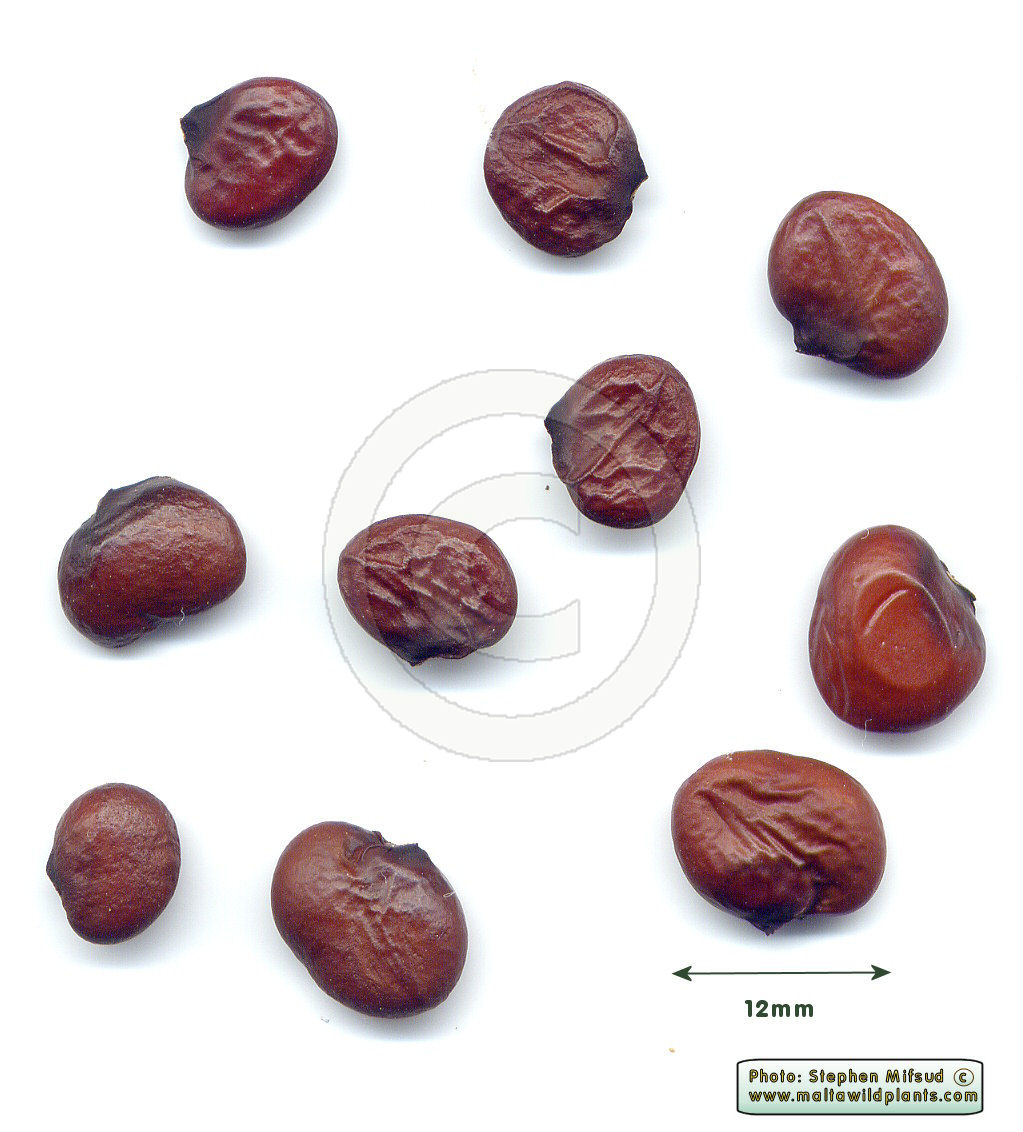
16-32

Flattened oval

8 - 10mm

Dark Brown

General
Picture

Wild Plants of the Mediterranean Islands of Malta  - Copyright Stephen Mifsud / Maltawildplants.com / Malta (2002-2007) Wild Plants of the Mediterranean Islands of Malta  - Copyright Stephen Mifsud / Maltawildplants.com / Malta (2002-2007) Wild Plants of the Mediterranean Islands of Malta  - Copyright Stephen Mifsud / Maltawildplants.com / Malta (2002-2007) Wild Plants of the Mediterranean Islands of Malta  - Copyright Stephen Mifsud / Maltawildplants.com / Malta (2002-2007)

FRUIT AND OTHER BOTANICAL DATA:

Characteristic

Fruit Type

Colour of Fruit

Subterranean Parts

Other Notes

Description

Dehiscent Loculicidal Capsule :

A fruit capsule that splits open longitudinally into the cavity of the locule when the seeds are ripe.

Green

Turns beige when it ripens.

Rhizome :

A prostrate or underground plant stem, forming shoots above and roots below.They serve as a reproductive structure and sometimes have thickened areas that store starch.

-

General
Picture

Wild Plants of the Mediterranean Islands of Malta  - Copyright Stephen Mifsud / Maltawildplants.com / Malta (2002-2007) Wild Plants of the Mediterranean Islands of Malta  - Copyright Stephen Mifsud / Maltawildplants.com / Malta (2002-2007) Wild Plants of the Mediterranean Islands of Malta  - Copyright Stephen Mifsud / Maltawildplants.com / Malta (2002-2007) Wild Plants of the Mediterranean Islands of Malta  - Copyright Stephen Mifsud / Maltawildplants.com / Malta (2002-2007)

Plant Description

Life Cycle:

Perennial

Habitat:

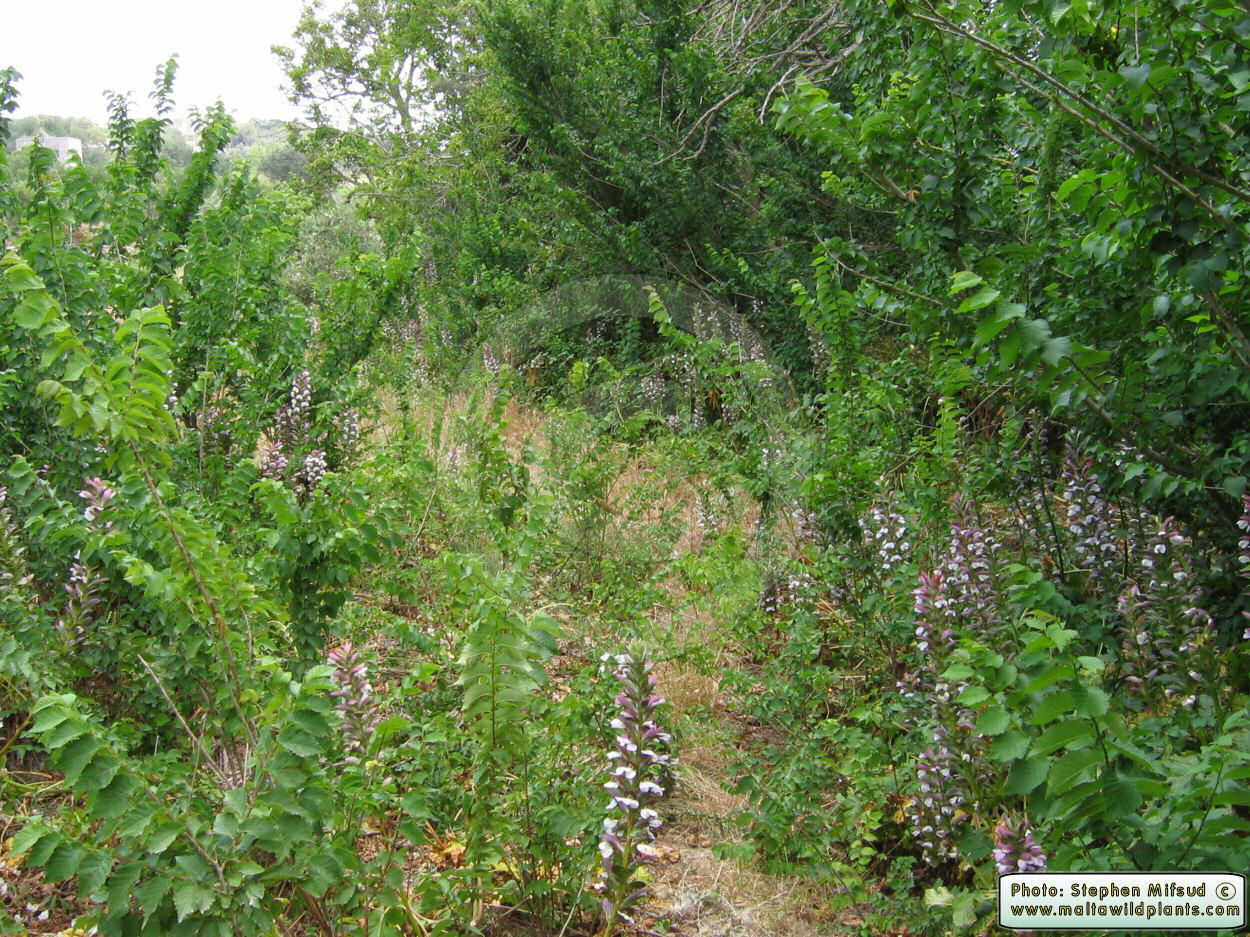
Meadow, woodland (beside trees) cool and rocky places, dappled shade.

Frequency:

Common

Sources in Malta:

Examples include Buskett woodlands, Chadwick Lakes, Wardija, Wied Babu, Wied Anglu. Throughout Malta and seems to be increasing in numbers.

Plant Height:

40 - 180cm in height.

Flowering Time:

Apr - Jun

Poison:

Not Poisonous

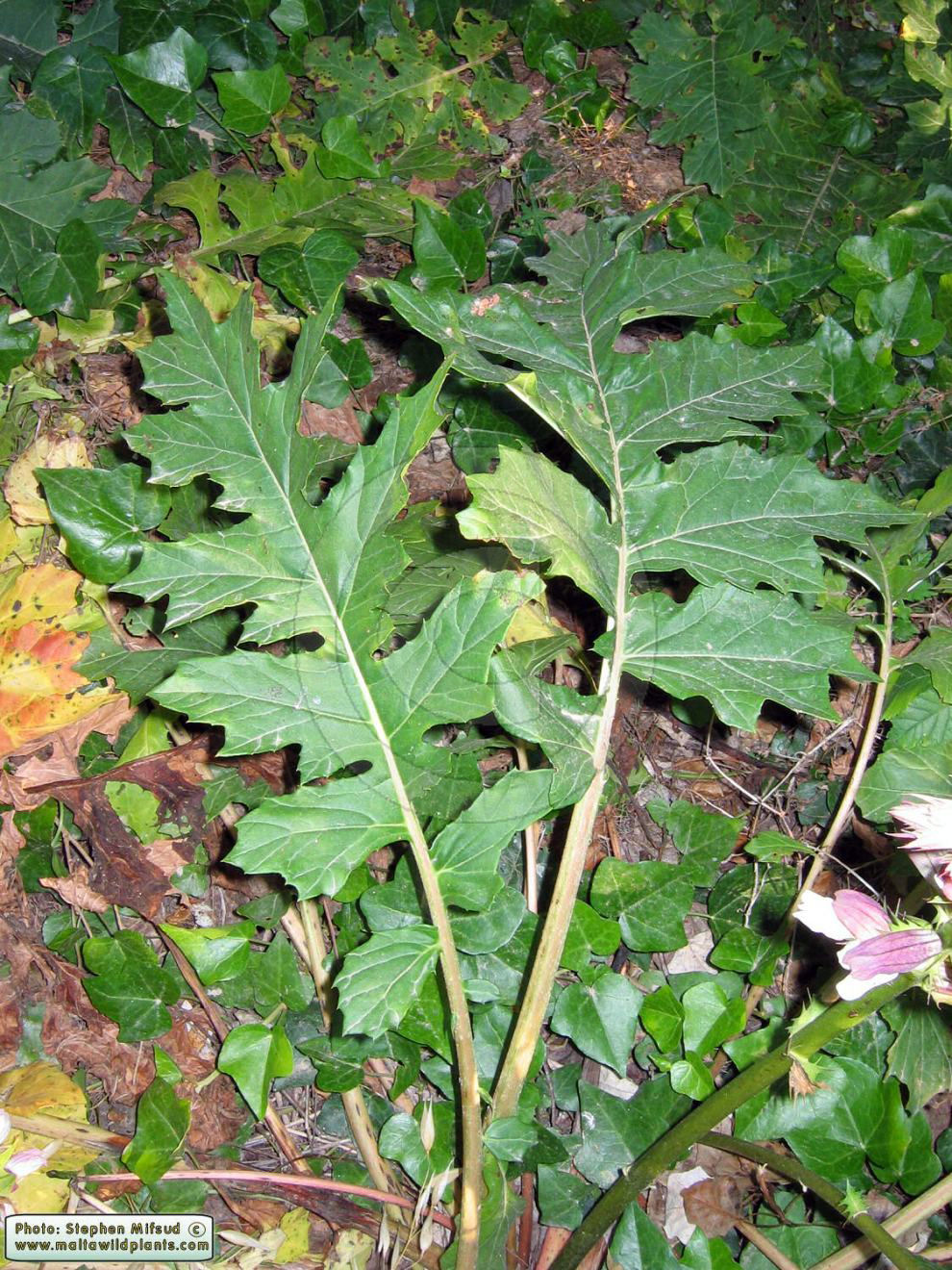
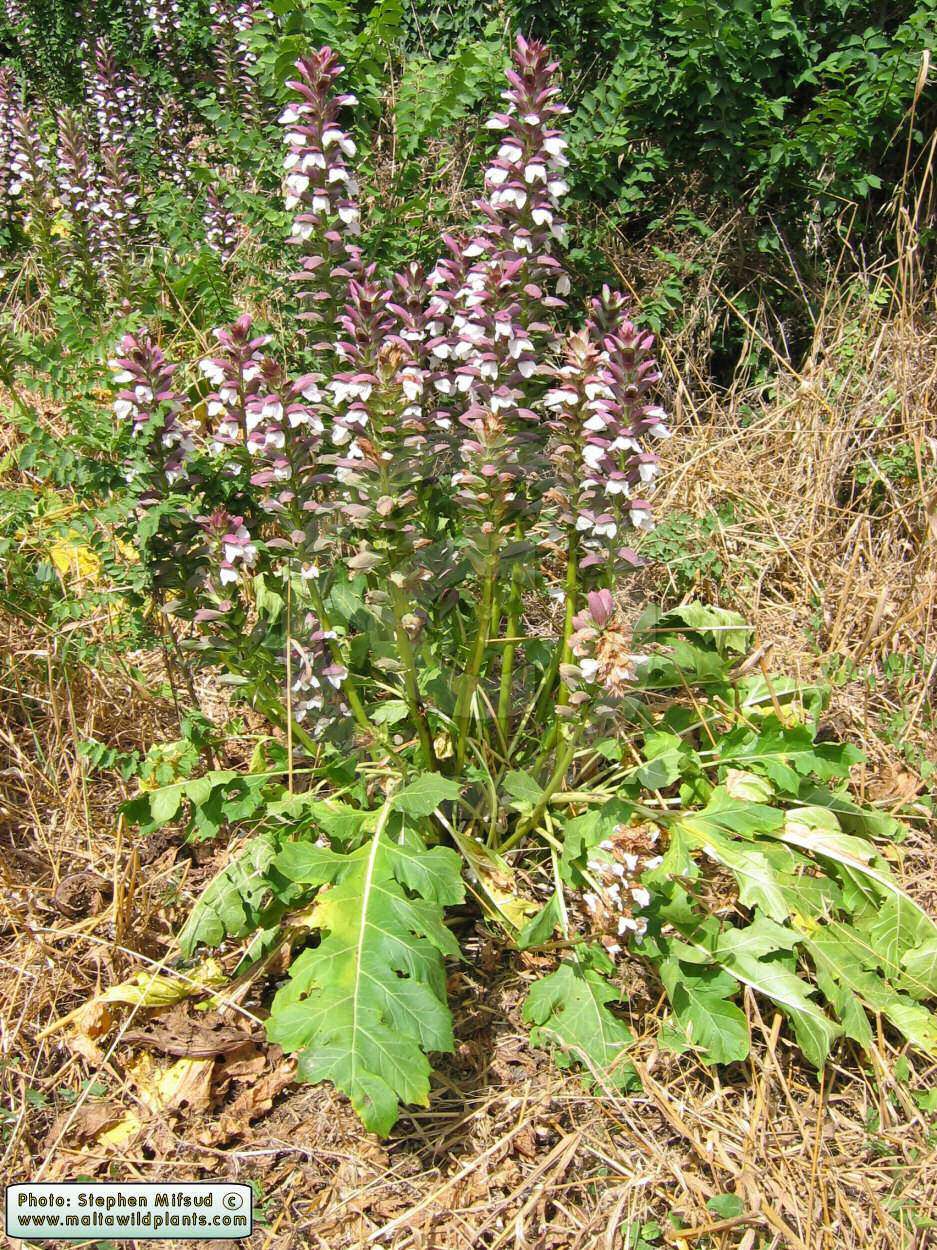
This plant is seen only in spring and early summer, but it is described perennial since its underground rhizome which stays alive all year round and shoots its stalks when spring arrives. The plant does not have a true upright stem, but instead it has a short and stubby one which lies horizontally just under ground level. From this stem, numerous leaf stalks and some flower stalks grow up. Occasionally mature flower stalks produce pairs of leaves. The erect flower stalks can reach over 1 metre (including the inflorescence), while the leaf stalks, which are also long, usually bend down making the leaves lie onto the ground.

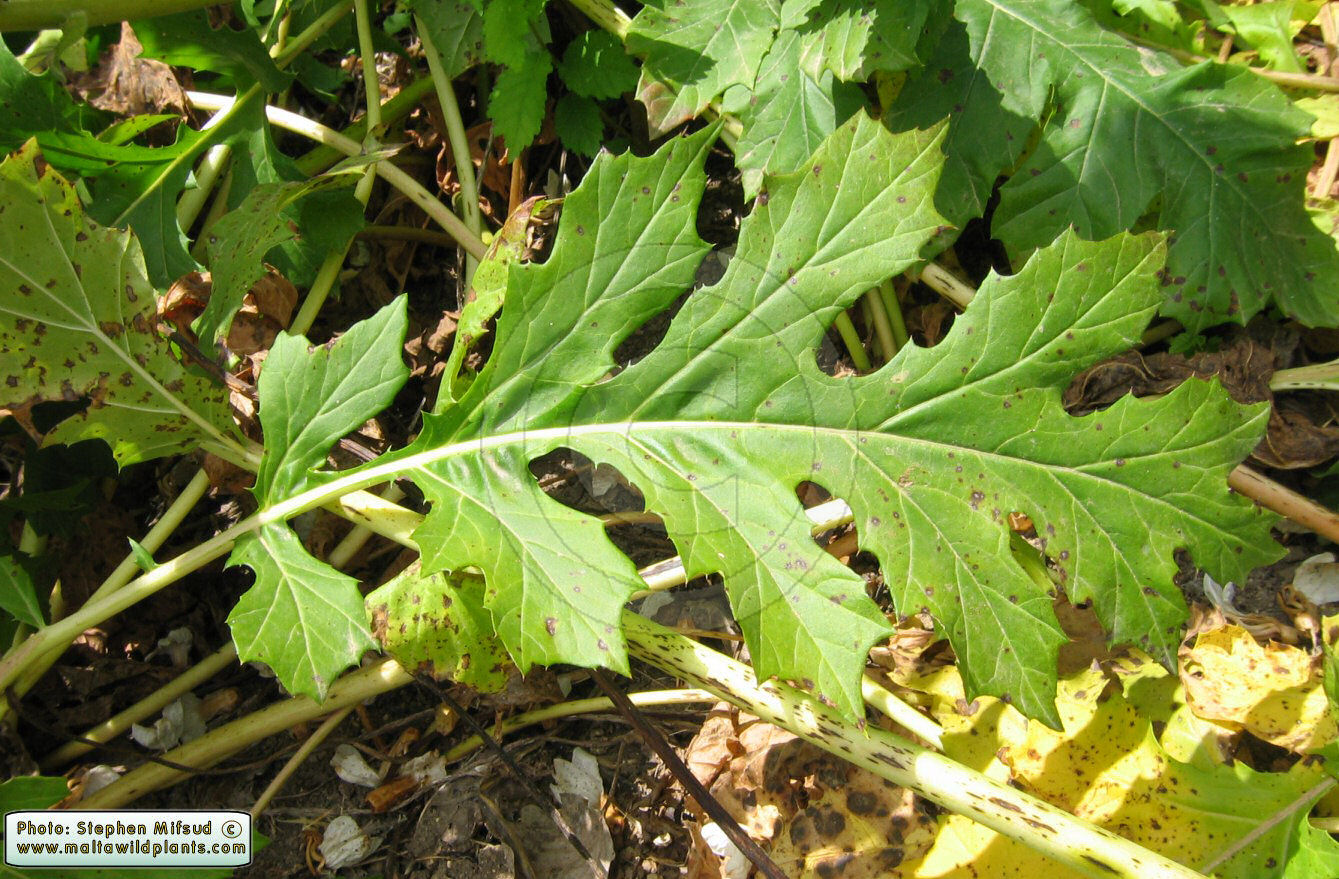
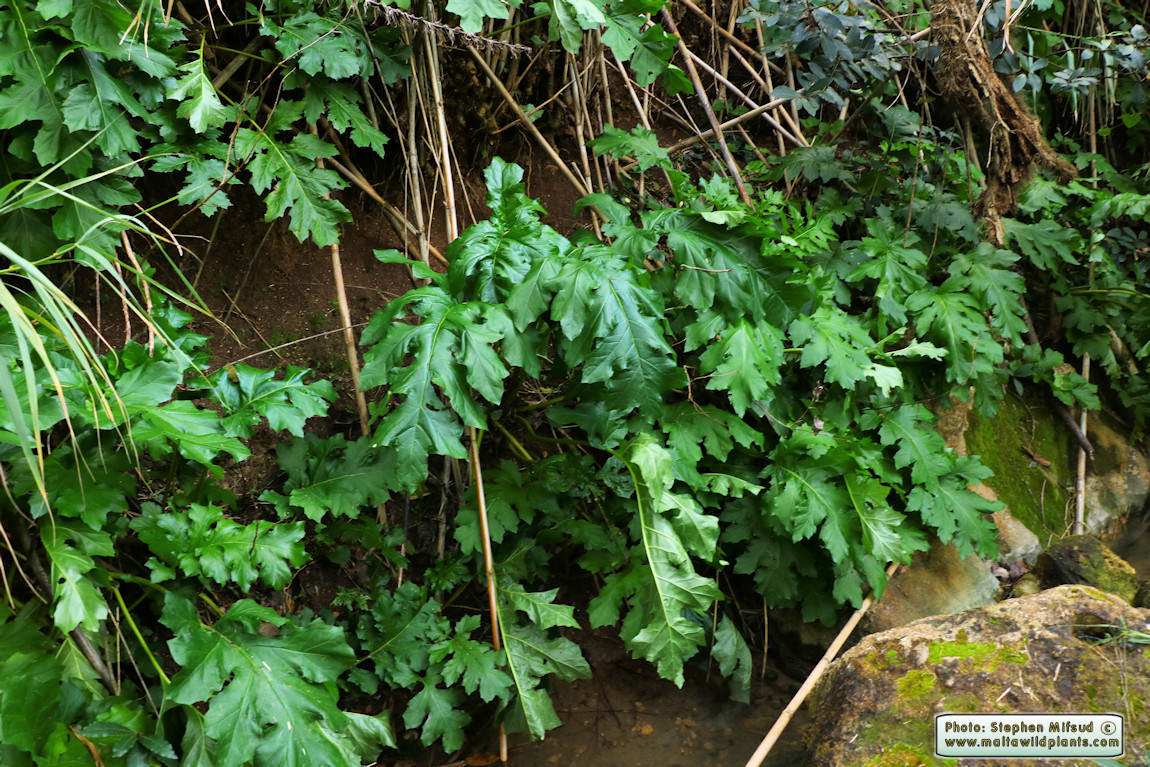
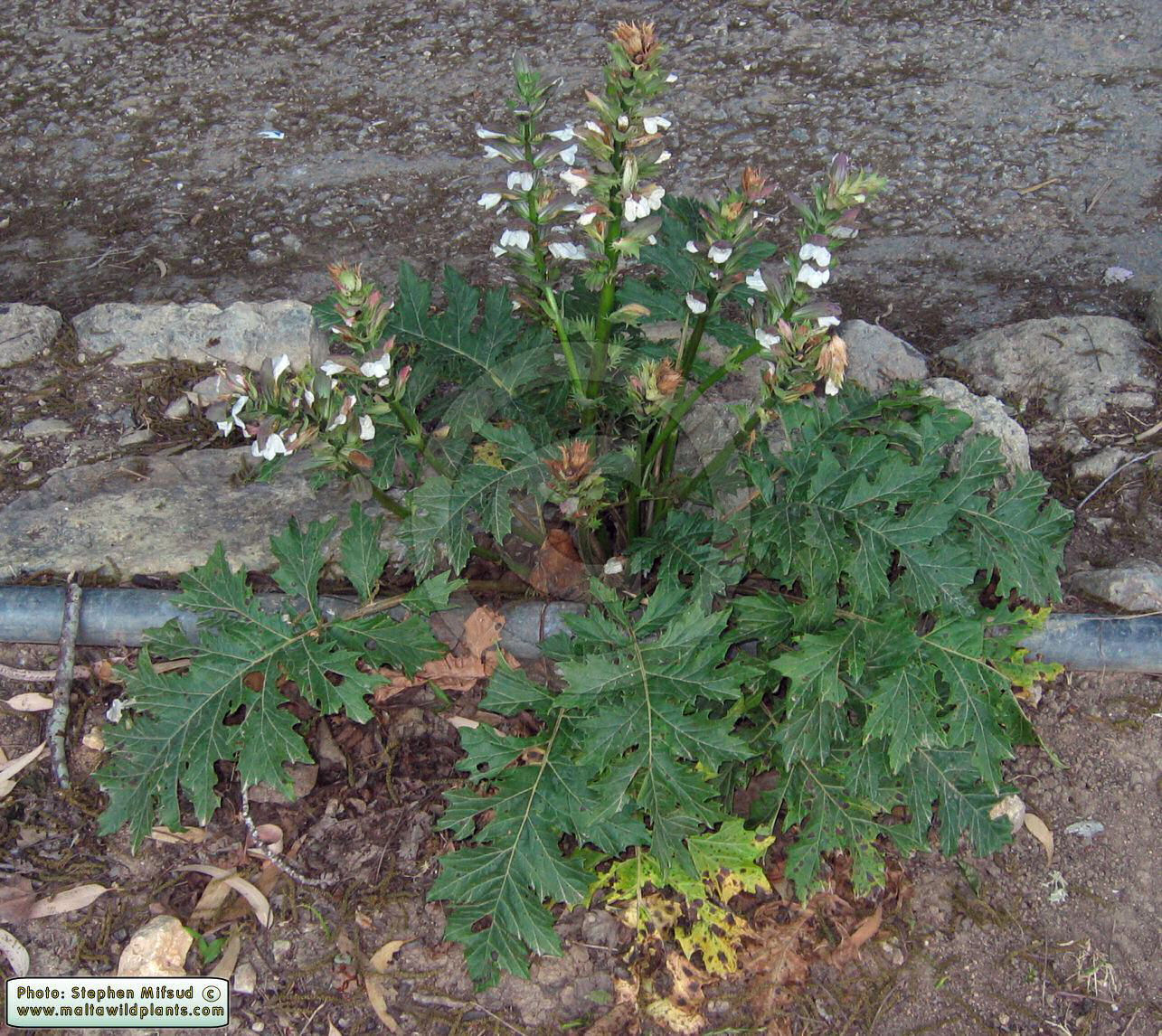
The leaves grow very large. Their size varies according to the maturity of the leaf but can reach a length of 40cm (excluding stalk) and width of about 25cm. The shape of the leaf is very elegant. There is one leaf blade per stalk which is divided into several, opposite lobes, the lower ones being larger and reaching the rachis (midrib). The leaf lobes themselves often form smaller lobes or dentations which run more or less oppositely forming a bilaterally symmetrical leaflet. Another feature that contributes to the leaf elegancy is the texture, it is very soft, described as the skin of a baby and does not possess any spines or hairs. The species name 'mollis' (= soft) is without doubt given for the leaf texture.

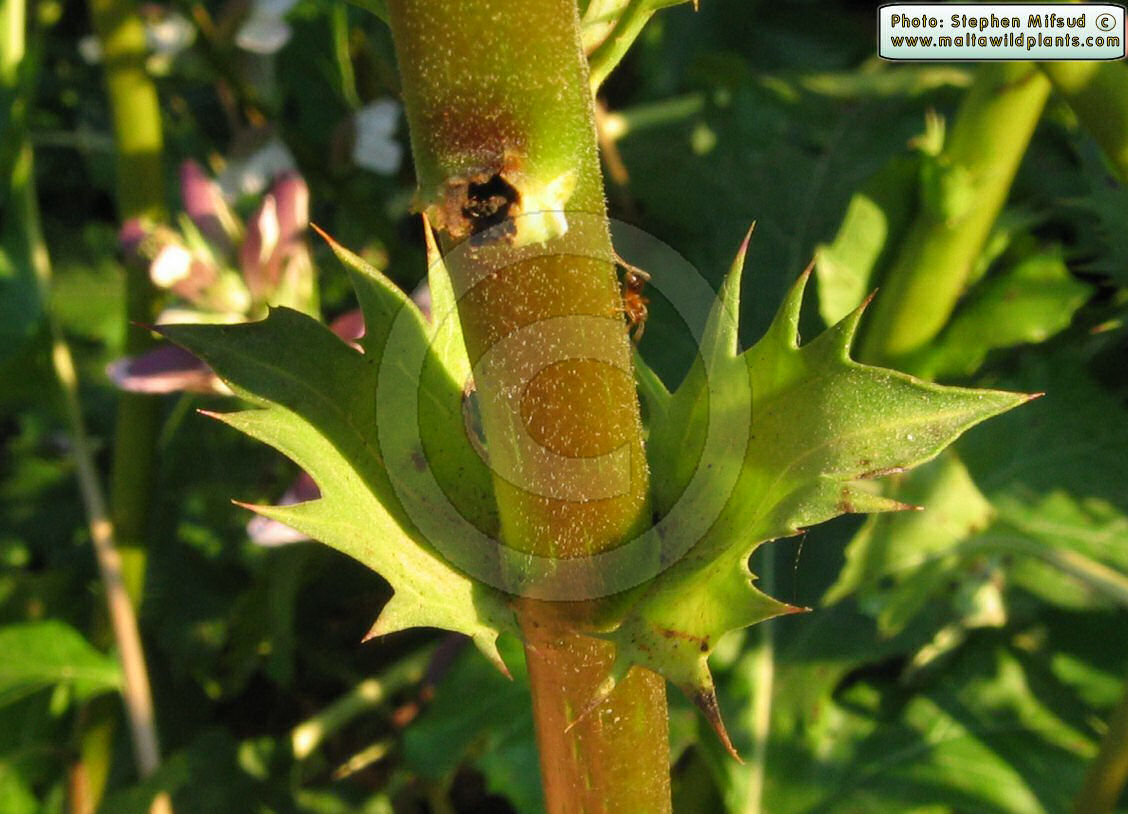
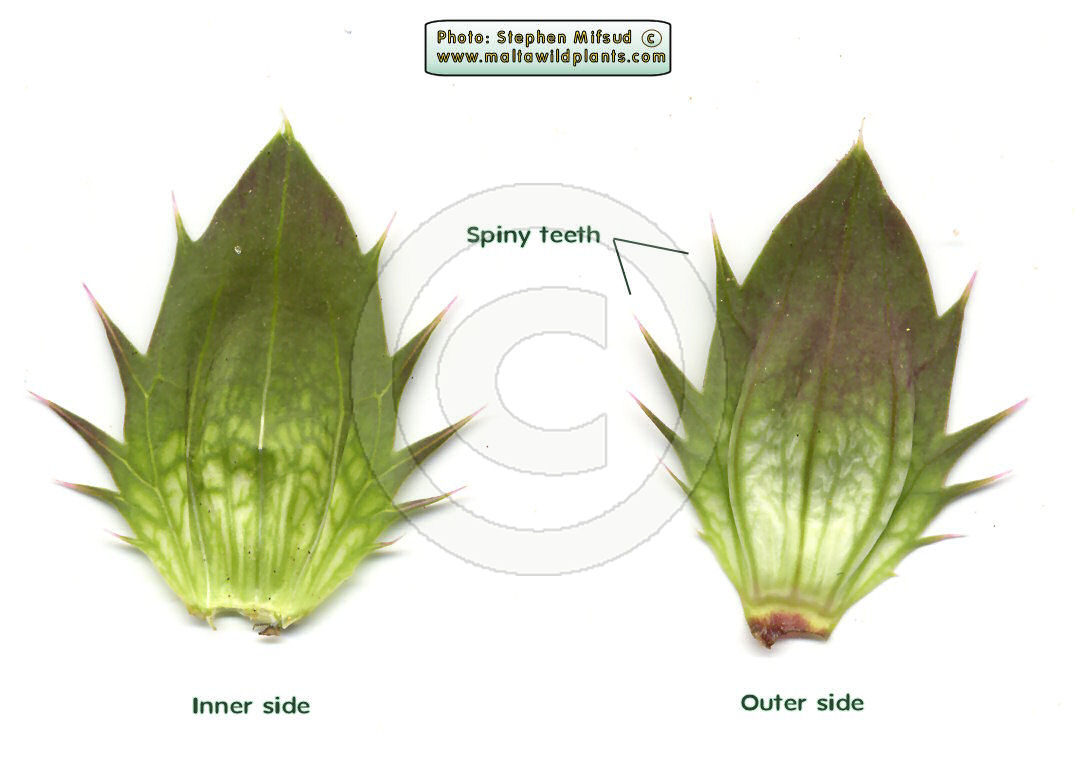
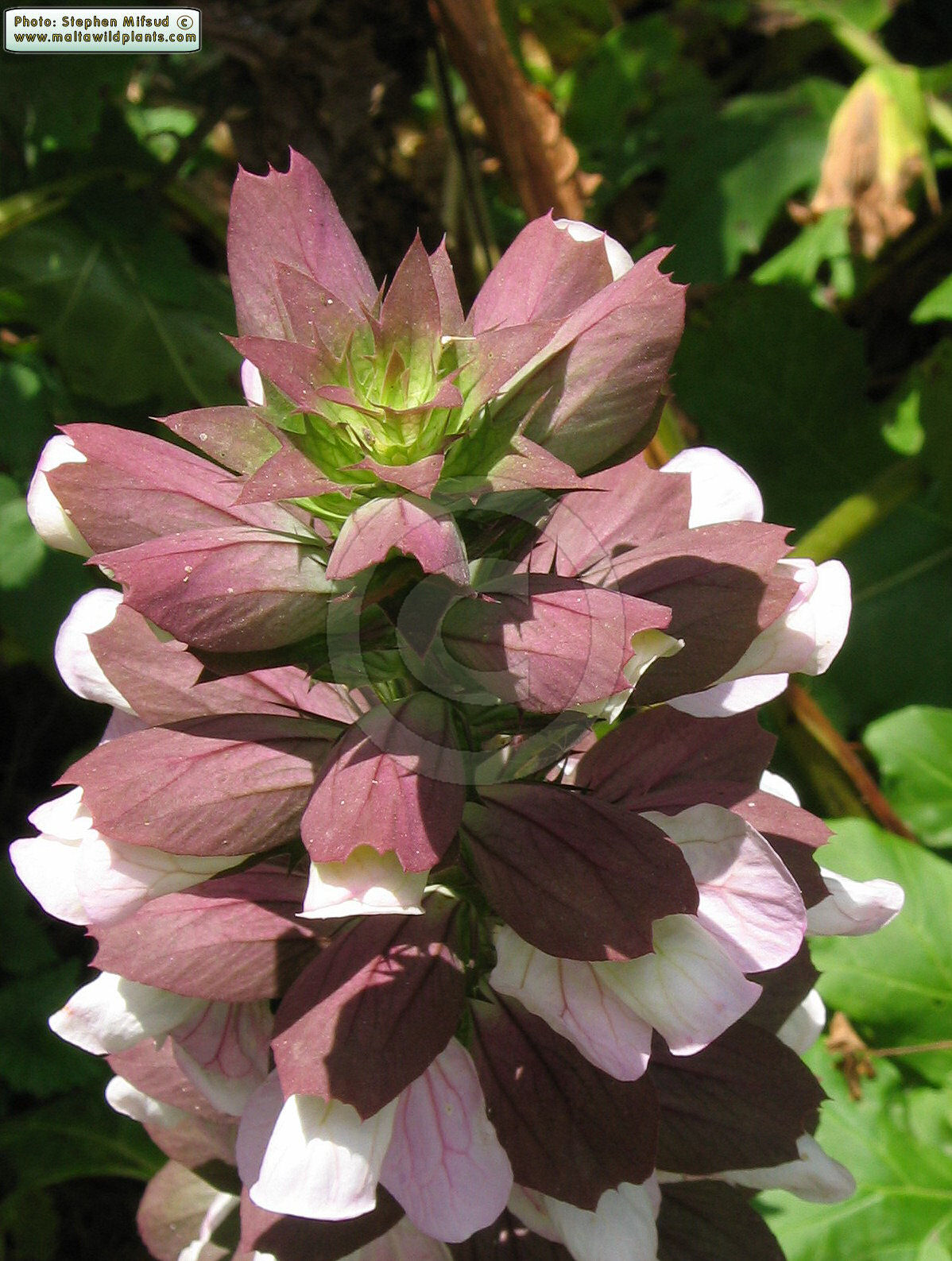
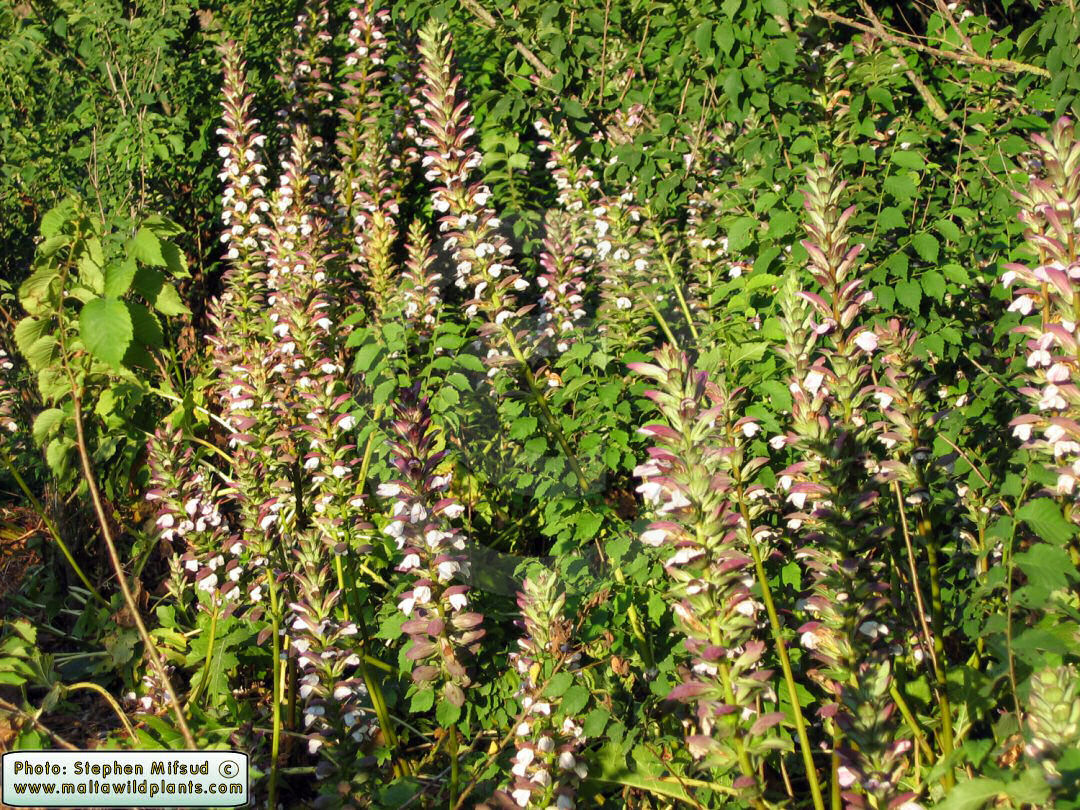
The numerous flowers grow along the upright flower stalk as a medium-dense spike. A normal spike of 60cm length can produce 100 -120 flowers. Each stalkless flower is bilaterally symmetrical and measures roughly 2cm long x 4cm wide x 5cm deep. The perianth is made of 4 different sepals and one lobed petal. The bract is closely associated with the flower and is rounded with opposite spiny teeth - these being the only spines which can be found in the whole plant.

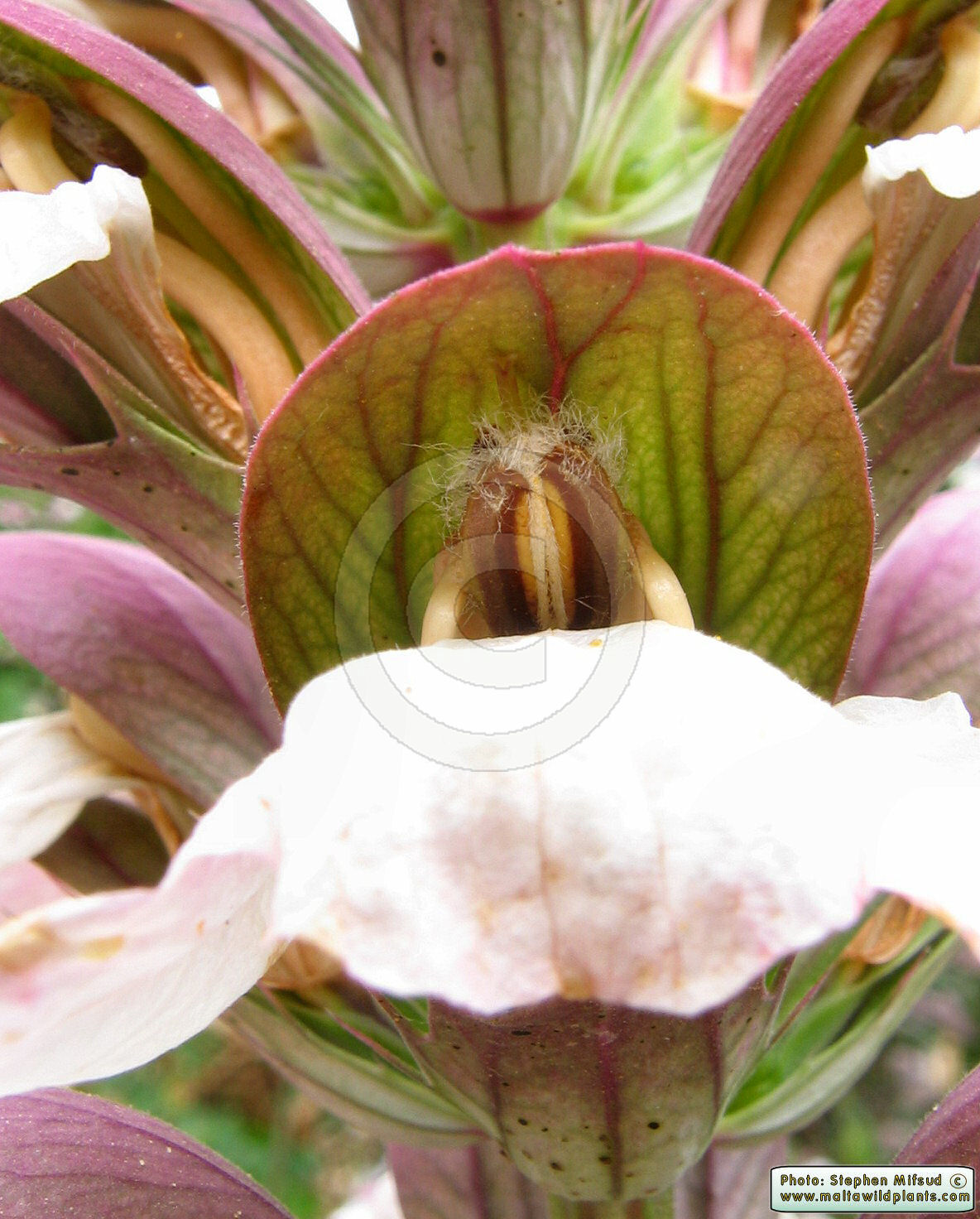
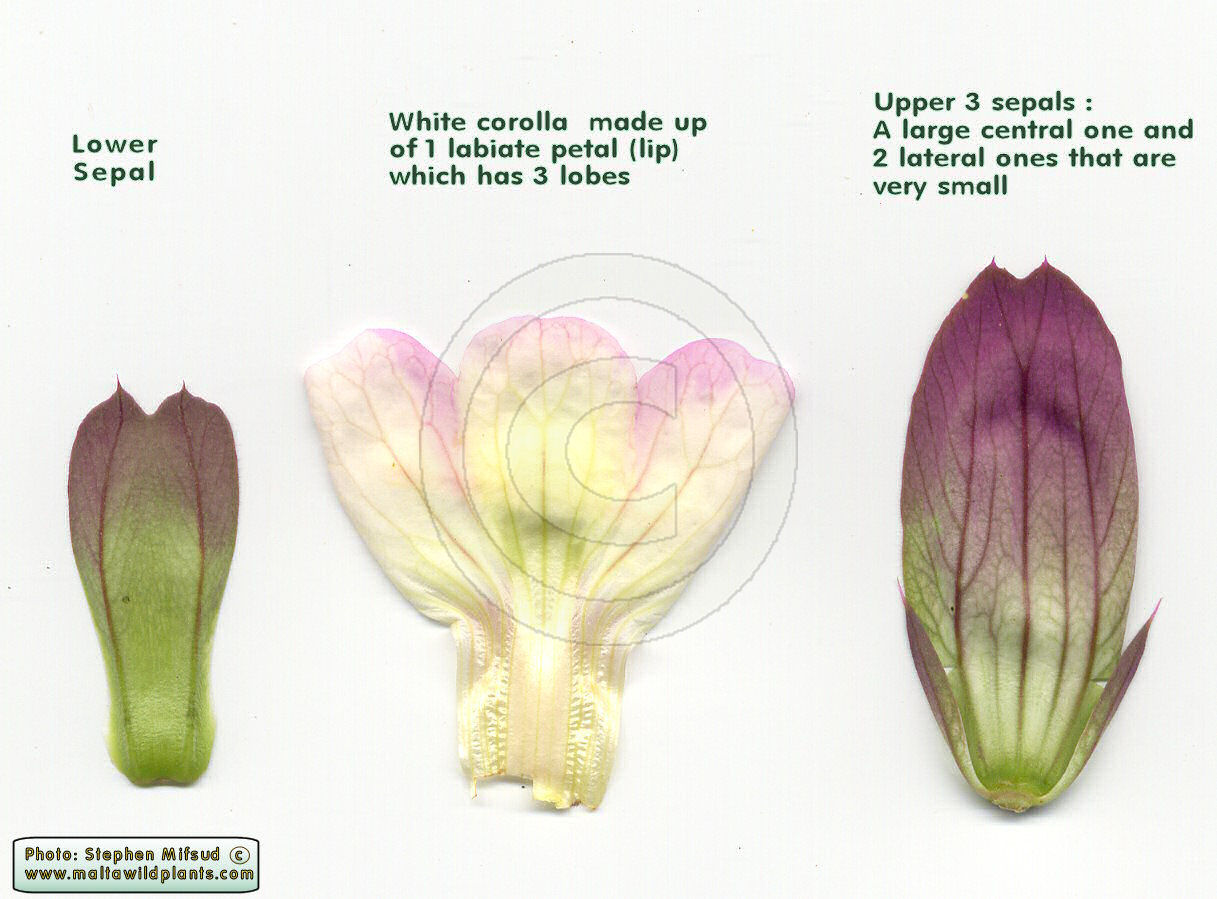
The flower consists of 4 sepals - one lower and 3 upper which have a green colour at their base that turn to purple-brown on the outer part. Only the upper central sepal is conspicuous because the lateral sepals are very small and the lower one is covered by the bract and barely seen. The upper central sepal is also more purple than green and has the shape of a hood. In contrast, the single labiate petal is white, often with a lavender / lilac tinge and is divided into 3 lobes. When the flower blooms, the petal hardens but does not wither (becoming like 'paper') and so the flowers remain white and in good shape for many days.

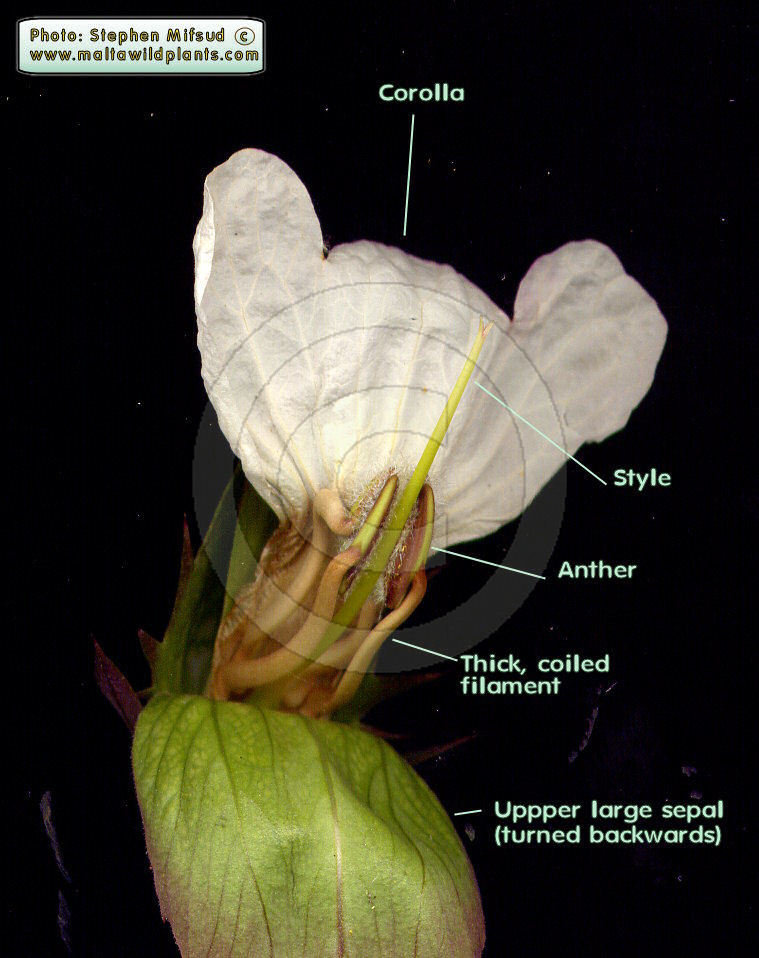
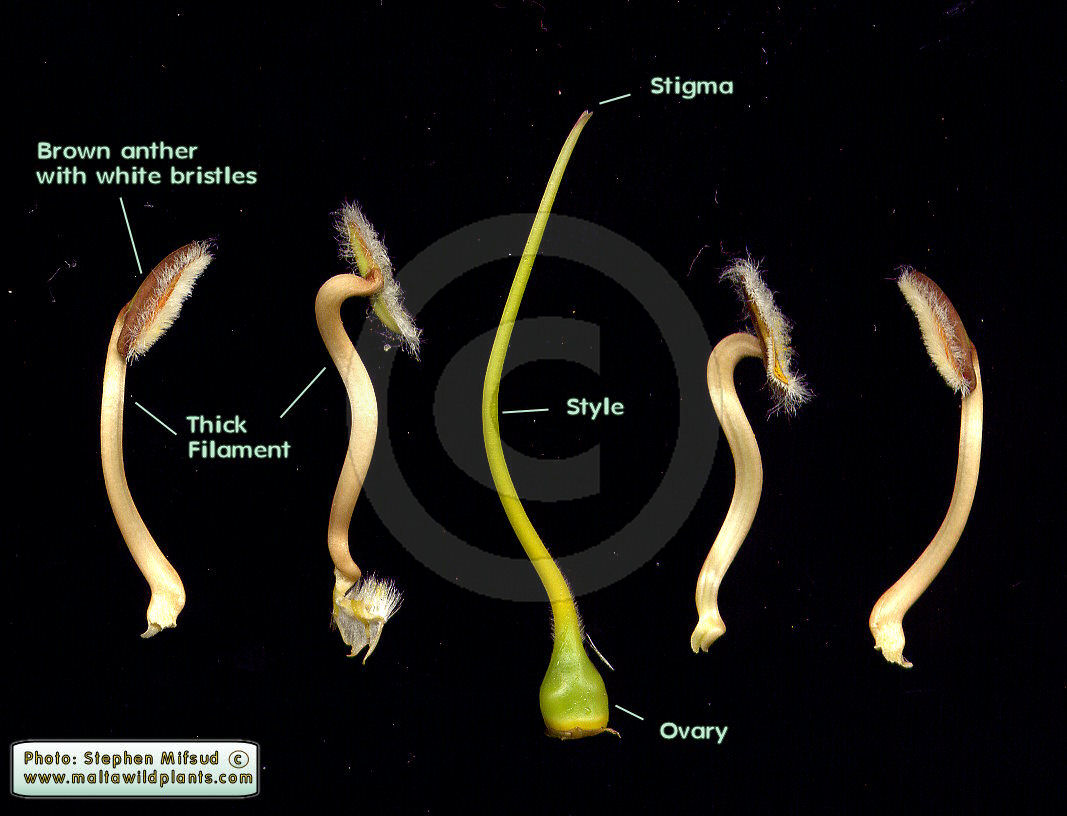
Inside the flower, and slightly visible from the exterior are the 4 stamens which are quite large and bulky. They are of equal length and arranged in a way that the 4 anthers are touching each other laterally. Each stamen has a twisted or bent, thick filament and a brown semi-eliptic anther which has many fine white bristles at one end from where the mustard-yellow pollen is liberated. The pistil consists of an inferior globular ovary, and a green style which passes just above the stamens. The stigma is indented into 2 tiny tips.

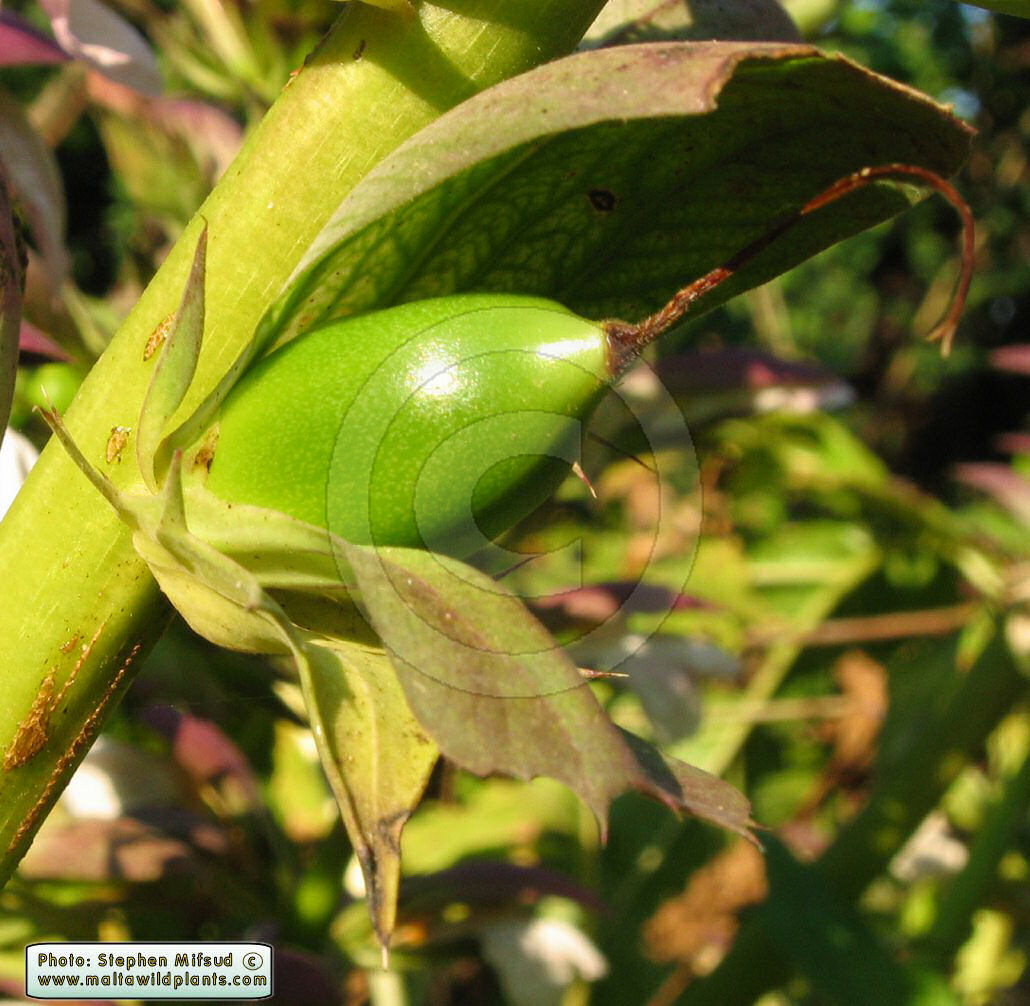
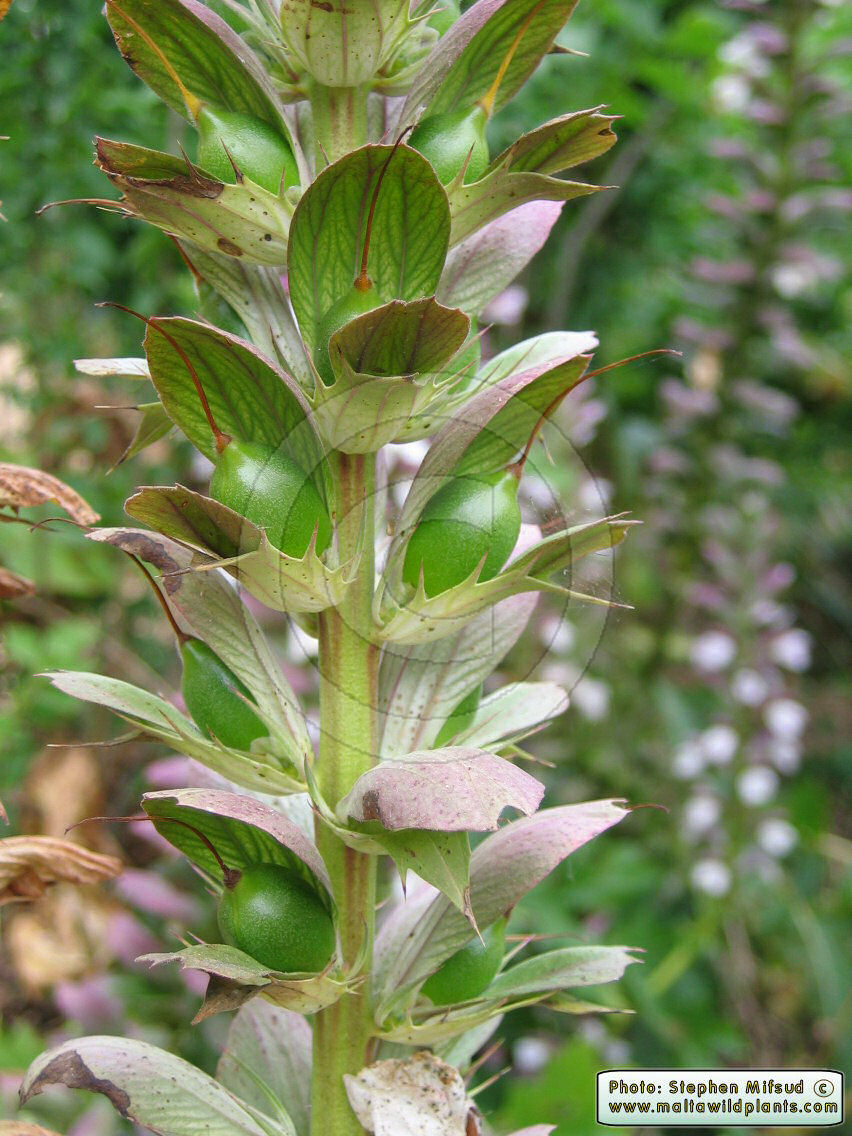
The ovules develop inside the fruit capsule that grows quite large, about 3cm x 2cm. The fruit is glabrous - sometimes shiny, lemon shaped and has a green colour. With maturity, the fruit hardens up and when ripe enough it breaks open and expels out the dark reddish brown seeds away to a considerable distance. The seeds have a hard, slightly wrinkled seed coat and their shape is oval and flattened. If the seeds are unsuccessful, the plant grows again from the extensive underground roots which are difficult to eradicate.


Additional Information


Origin and Nativity

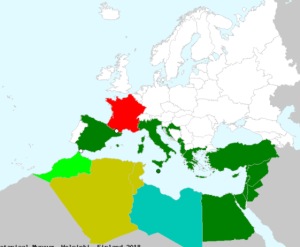
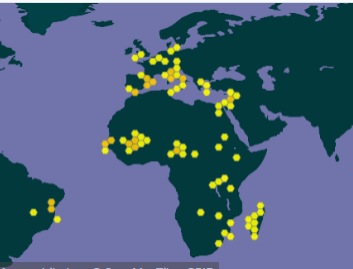
The plant is believed to have originated from southwest Europe [WWW-14] and now is Native across North Africa (eg: Algeria, Morocco, Tunisia), Western Asia (eg Turkey, Syria) and South and South-Eest of Europe ( Yugoslavia, Spain, France, Italy Sicily, etc) [WWW-26] . Naturalised in Britain in W. Cornwall [17]

Medicinal Uses

The plant has the following medicinal properties:   [7, 61, 254, WWW-66] .
Anti diarrheic used to control or stop diarrhoea (frequent discharge of loose or fluid evacuations from the intestines)    [WWW-32]
Astringent Causes shrinkage and drying of surface membranes when applied topically .    [271]
Depurative An agent which is able of Purifying the blood or the humours (body fluids)    [WWW-32]
Detergent a medicine used to cleanse wounds, ulcers, etc.    [WWW-32] < /td>
Emollient substances resembling cream that have a soothing and moisturising effect when applied to the skin.    [WWW-32]
Expectorant used to induce the ejection of mucus, phlegm, and other fluids from the lungs and air passages by coughing or spitting.    [WWW-32]
Stimulant Produces a temporary increase of vital activity in the organism, or in any of its parts;    [WWW-32]
Stomachic A medicine that strengthens the stomach and excites its action.    [WWW-32]
Vulnerary Useful in healing wounds; adapted to the cure of external injuries;    [WWW-32]


The plant contains appreciable quantities of mucilage and tannin. Traditionally it was used as a treatment for dislocated joints and for burns. A paste made from the plant, when applied to a dislocated joint, tends to normalise the affected muscles and ligaments, simultaneously relaxing and tightening them to encourage the joint back into its proper place [254] . The crushed leaves have been used as a poultice to soothe burns and scalds [268] . For internal use, the plant's emollient properties are useful in treating irritated mucous membranes within the digestive and urinary tracts [254] .

Other Uses

The sub-species A. mollis latifolia makes a good ground cover plant [208] . Relatively slow to cover the ground at first but it can eventually become invasive [197] .

Cultivation details

Prefers a deep loamy soil in a sheltered position in full sun [1] but tolerates partial shade [31, 111] . Grows well in heavy clay soils if they are well-drained but dislikes heavy damp soils [111] and will not overwinter in wet soils [200] . Established plants are fairly drought tolerant [190] .

Hardy to about -15°c [187] , though young plants may require protection in the winter [190] and even older ones may need protection in cold winters [111] .

A very ornamental plant [1] . The leaves can wilt on hot summer days when plants are grown in full sun [190] . Plants can become invasive [197] , spreading by suckers, and they are difficult to eradicate due to their deep roots [190] . Does well in the lawn or wild garden [111] . Plants can be grown in quite coarse grass, which can be cut in the autumn [233] .

Members of this genus are not usually browsed by deer [233] .

Propagation Details

From Seed: - sow spring in a cold frame [133, 200] or outside as soon as the seed is ripe [133] . It usually germinates in 3 - 4 weeks at 10°c [133] . When they are large enough to handle, prick the seedlings out into individual pots and grow them on for two years before planting out in late spring or early summer [200, KF] .

A further hint for more successful growth from seeds is found in reference [WWW-67] :
" Scratch seed with a nail and then soak in warm water for three days, changing the water every eight hours with fresh warm water. Sow by covering the seed completely, darkness needed for best results, germination is often in 10 days at 70 F but can be spread-out over a few months too. This depends on how fresh the seeds are, new seeds take a long time to germinate and old seed is happy to germinate quicker. One can also leave the seeds out to dry for a few weeks before soaking. "

Division in spring or autumn [111, 200] . Very easy, they can be planted straight out into their permanent positions.

From root cuttings: - winter in a cold frame [111, 200] .

Relationship between Acanthus and the Corinthians

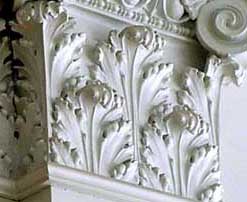
Greek Architecture by Corinthians with Acanthus leaves It is a well known fact that Leaves of Acanthus species namely A. mollis is used in architecture as ornamentation in the capitals (upper extremity of a column). The Corinthian order was one of the Classical orders of Greek and Roman architecture, although it was seldom used in Greek architecture. The other two orders were the Doric and the Ionic. (When classical architecture was revived, two more orders were added to the canon, the Tuscan order and the Composite order.) [WWW-69] .

Click below for examples of Greek architecture by Corinthians with depictions of the Acanthus leaves:
Example 2 Example 3 Example 4


The Corinthians made the most elaborate column of all other orders, with a much taller capital that showed acanthus leaves appearing to sprout from the column. The Pantheon in Rome offers fine examples of Corinthian columns. [WWW-70]

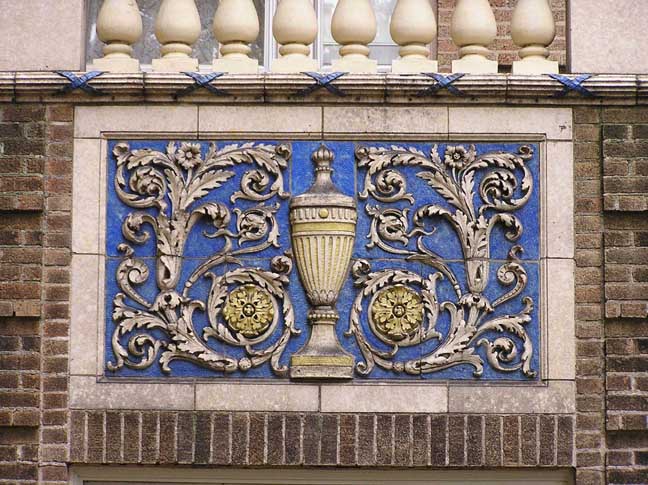
Apparently acanthus plant motifs appear extensively in Medieval, Renaissance artwork, particularly in sculpture and wood carving and in friezes. In architecture the frieze is the vertical part of an entablature, whether plain or decorated with bas-reliefs. It lies upon the architrave ('main beam') and is capped by the moldings of the cornice. In a looser sense, the frieze of a room is the section of wall above the picture rail under the crown moldings or cornice. By extension, a frieze is a long band of painted or modelled decoration in such a position, above eye-level.

History about the Corinthians and the Acanthus leaves

This citation [WWW-68] reports about the incidence of how Corinthians used the acanthus leaves in their architecture:

" The third order, which is called Corinthian, imitates the slight figure of a maiden; because girls are represented with slighter dimensions because of their tender age, and admit of more graceful effects in ornament.

Now the first invention of that capital is related to have happened thus. A girl, a native of Corinth, already of age to be married, was attacked by a disease and died. After her funeral, the goblets which delighted her when living, were put together in a basket by her nurse, carried to the monument, and placed on the top. So that they might remain longer, exposed as they were to the weather, she covered the basket with a tile. As it happened the basket was placed upon the root of an acanthus. Meanwhile about spring time, the root of the acanthus, being pressed down in the middle by the weight, put forth leaves and shoots. The shoots grew up the sides of the basket, and, being pressed down at the angles by the force of the weight of the tile, were compelled to form the curves of volutes at the extreme parts.

Then Callimachus, who for the elegance and refinement of his marble carving was nick-named catatechnos by the Athenians, was passing the monument, perceived the basket and the young leaves growing up. Pleased with the style and novelty of the grouping, he made columns for the Corinthians on this model and fixed the proportions. Thence he distributed the details of the Corinthian order throughout the work "

from: A Certain "Remarkable Circumstance" by
Vitruvius, On Architecture, (ca. 30 B.C.E.). Book IV, Chapter 1.

Personal Observations


Some morphological differences observed
Usually, and as described by many botanists, the flowering stalk does not branch and it just forms numerous flowers in form of a long spike. However there are some species or variants which are able to form few and simple flower branches from the main flower stalk. Sometimes such variants also form few stalked leaves (smaller than the normal ones) that grow in opposite directions. These features would make the 'flowering stalk' be defined as a stem, since it branches smaller flowering stalks and leaves [SM]

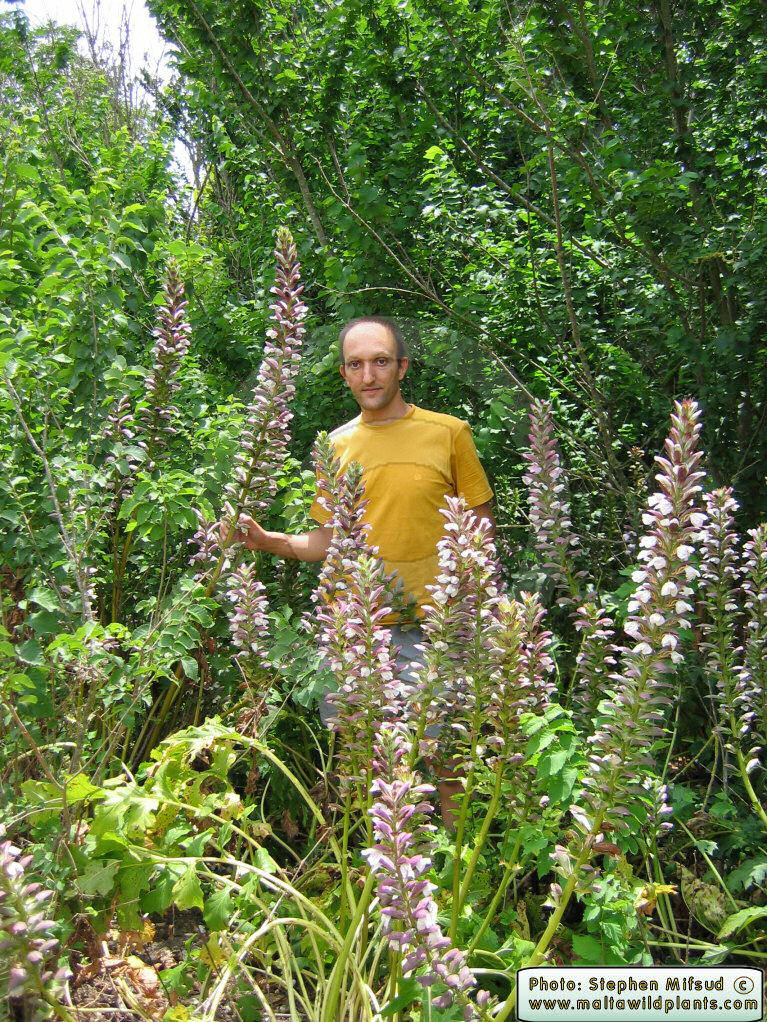
Another different feature is the plant height. This plant is usually described to reach a maximum of 120cm. Actually this is true for many plants but a few plants having a flowering stalk reaching 200cm in length were observed in Malta. Click here to see a photo with a plant taller than myself (172cm). This abnormal height is probably contributed by the habitat factors namely sunshine, water availability and soil nutrients [SM]
Long life of the flowers in situ and in vitro
A little after the blooming of the flower, the petal's texture changes from a soft one to a harsh and dry one - maintaining fully its shape and colour. In fact, when touching the petal, it feels as touching a dry paper rather than something smooth and 'fresh'. Thanks to this feature the petals persists on the plant for a long time and so, since the old lower flowers do not wither and drop down, long whitish flowering spikes are produced. Additionally, this plant is ideal to put in a vase because the flower spikes remain erect and keep producing flowers for at least 10 days, and as just described, the individual flowers do not wither and fall. [SM]

Photo Gallery

Acanthus mollis (Bear`s Breech) - CLICK TO ENLARGE PHOTO Acanthus mollis (Bear`s Breech) - CLICK TO ENLARGE PHOTO Acanthus mollis (Bear`s Breech) - CLICK TO ENLARGE PHOTO Acanthus mollis (Bear`s Breech) - CLICK TO ENLARGE PHOTO
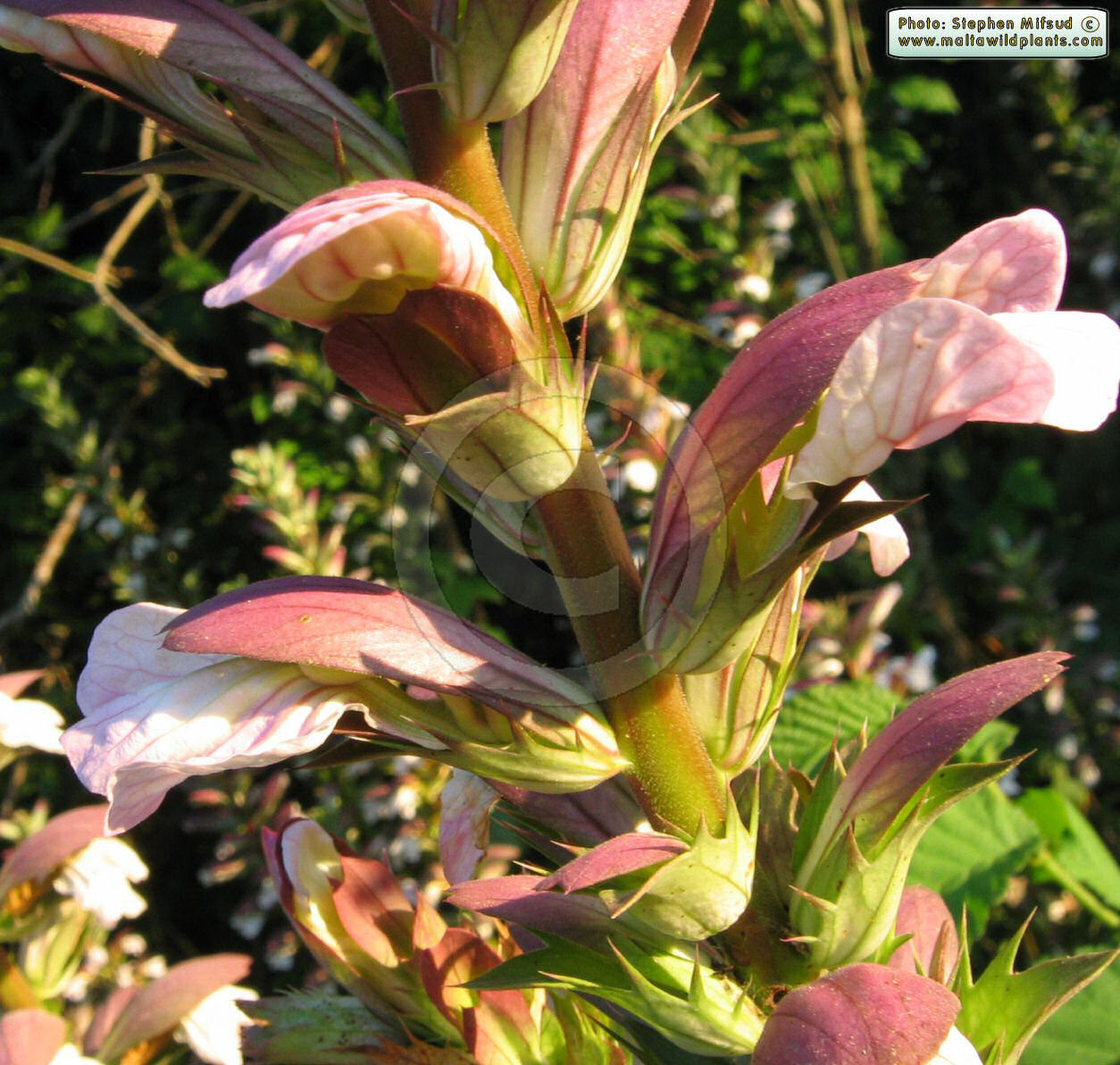
Photo of flowers in situ. The individual flowers are sessile and so the inflorescence is described as a spike.
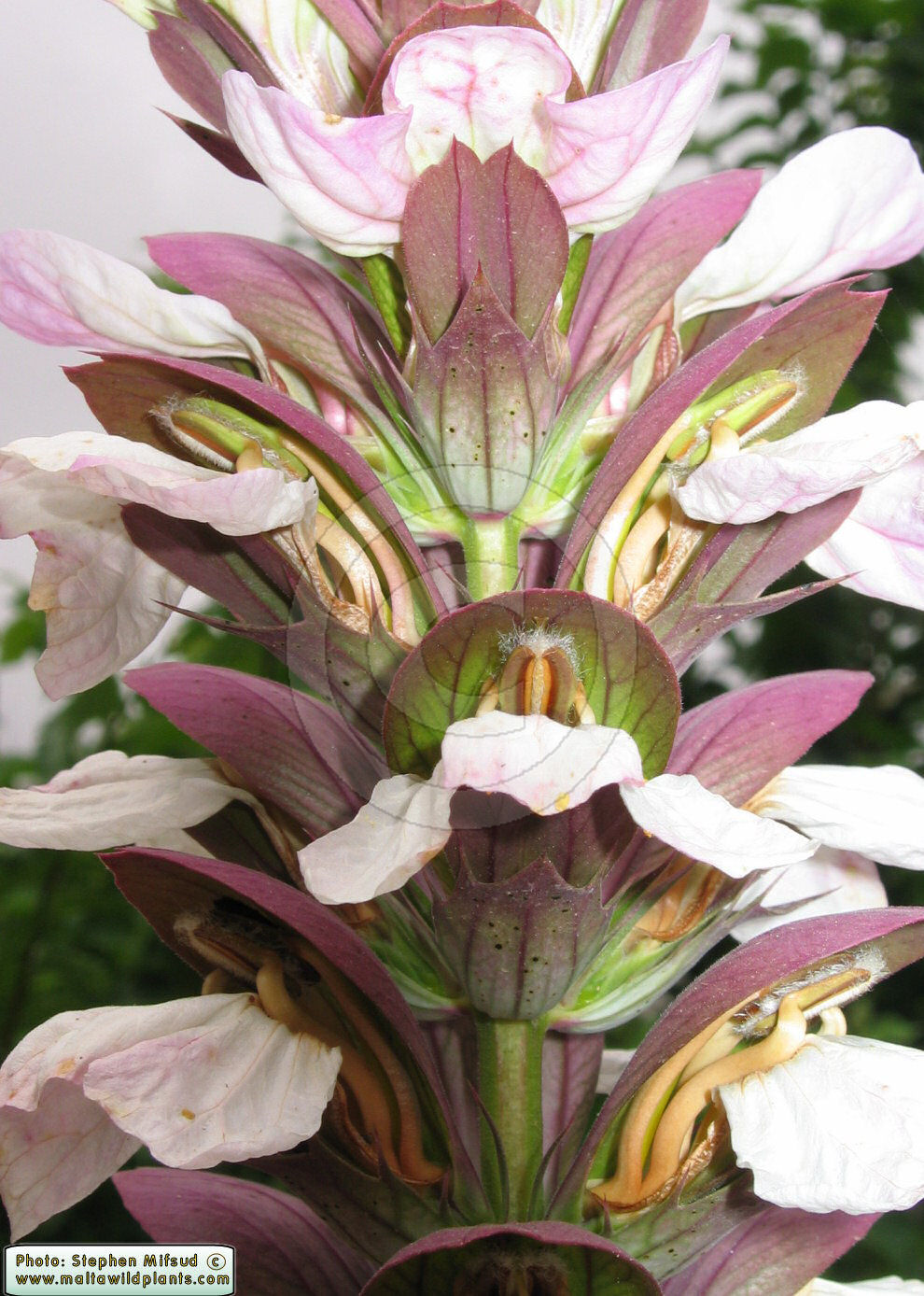
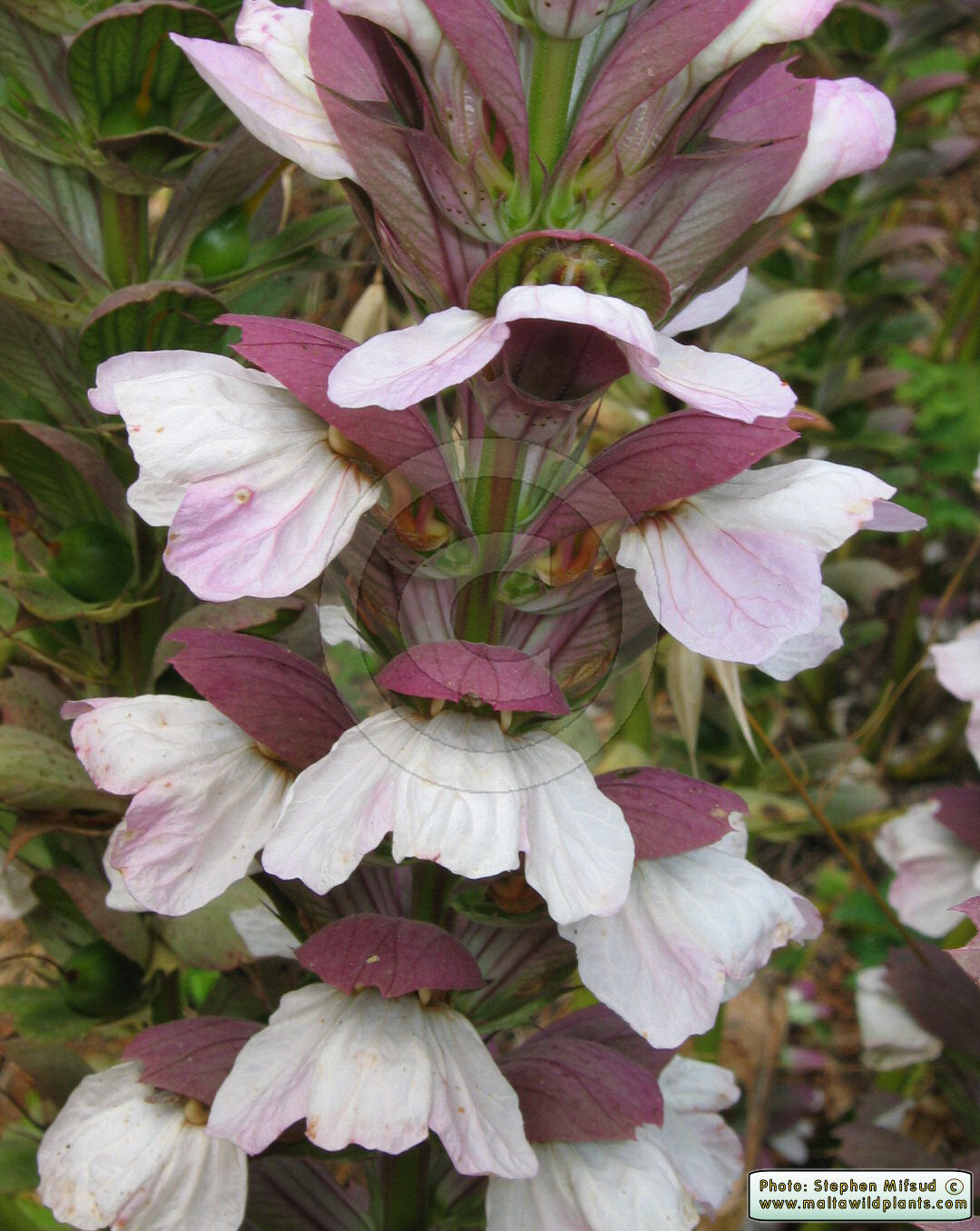
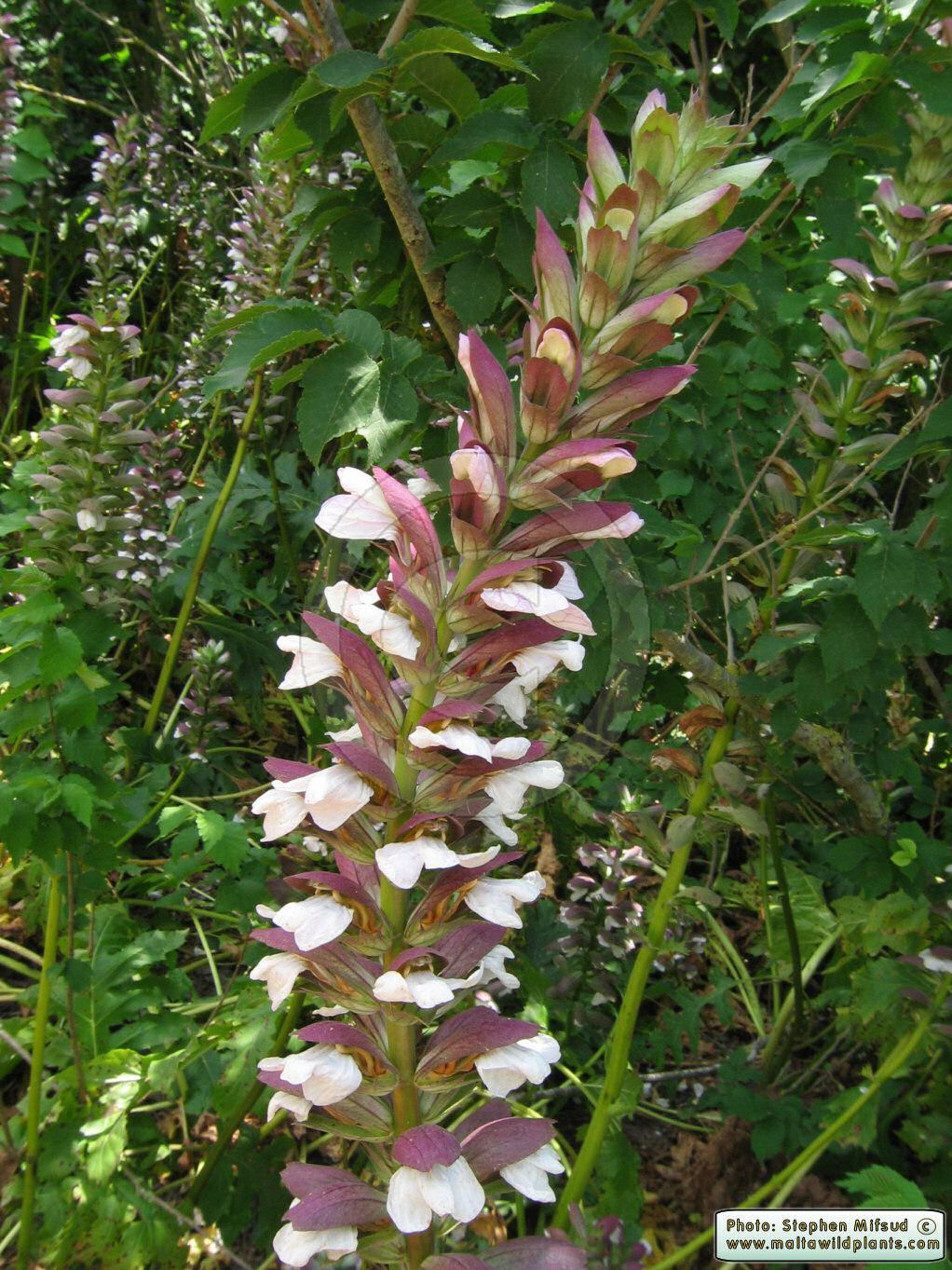
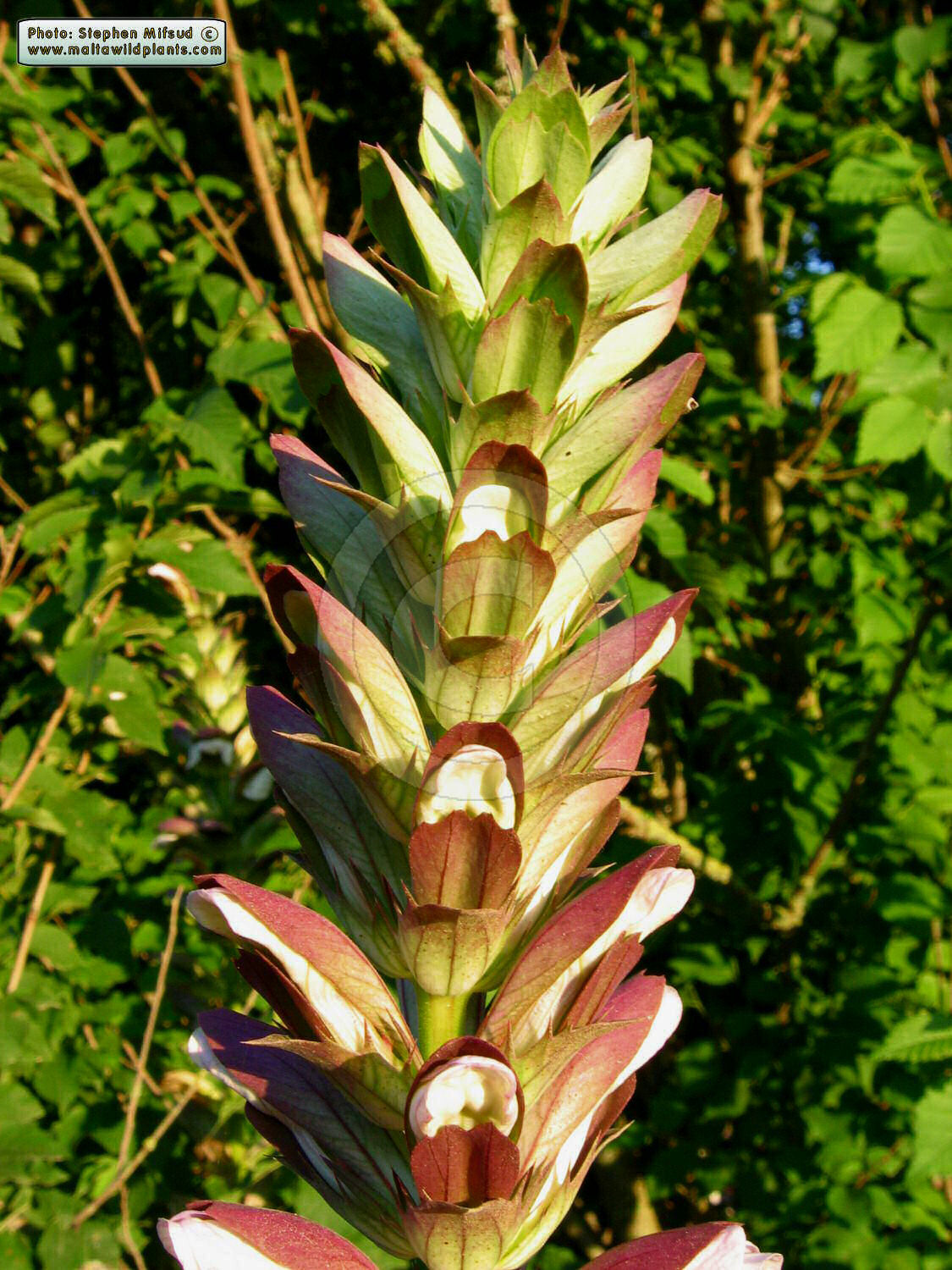
Photo of the flowering spike, consisting of several stacks of white- lipped flowers.
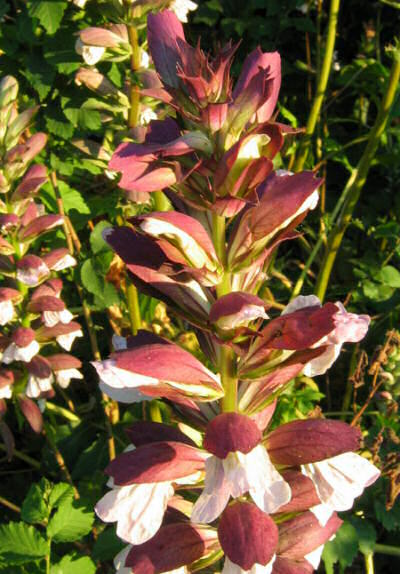
Photo of upper part of flowering spike.
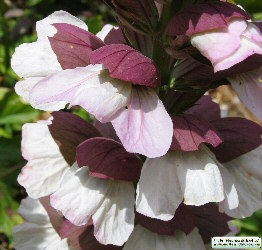
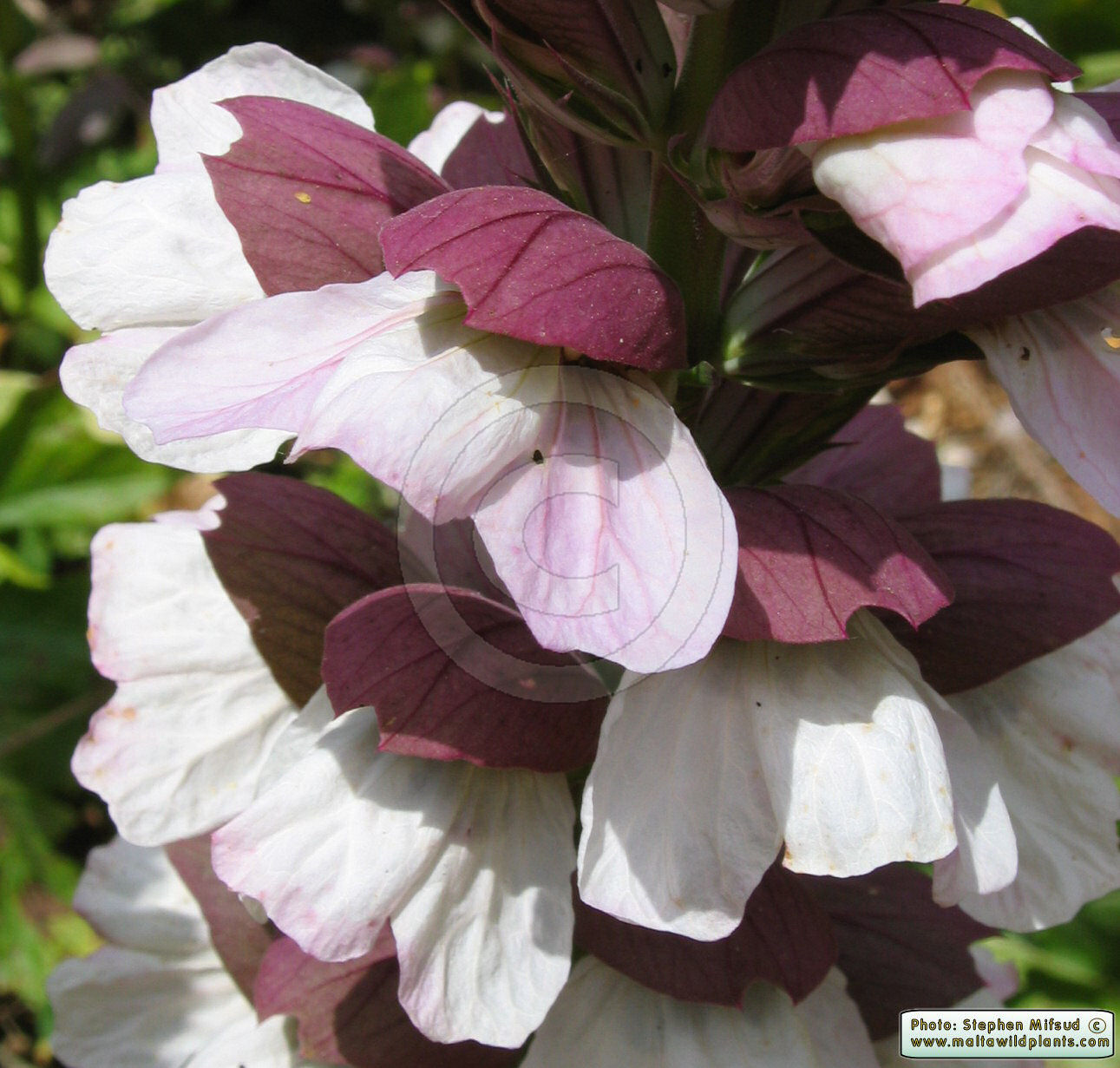
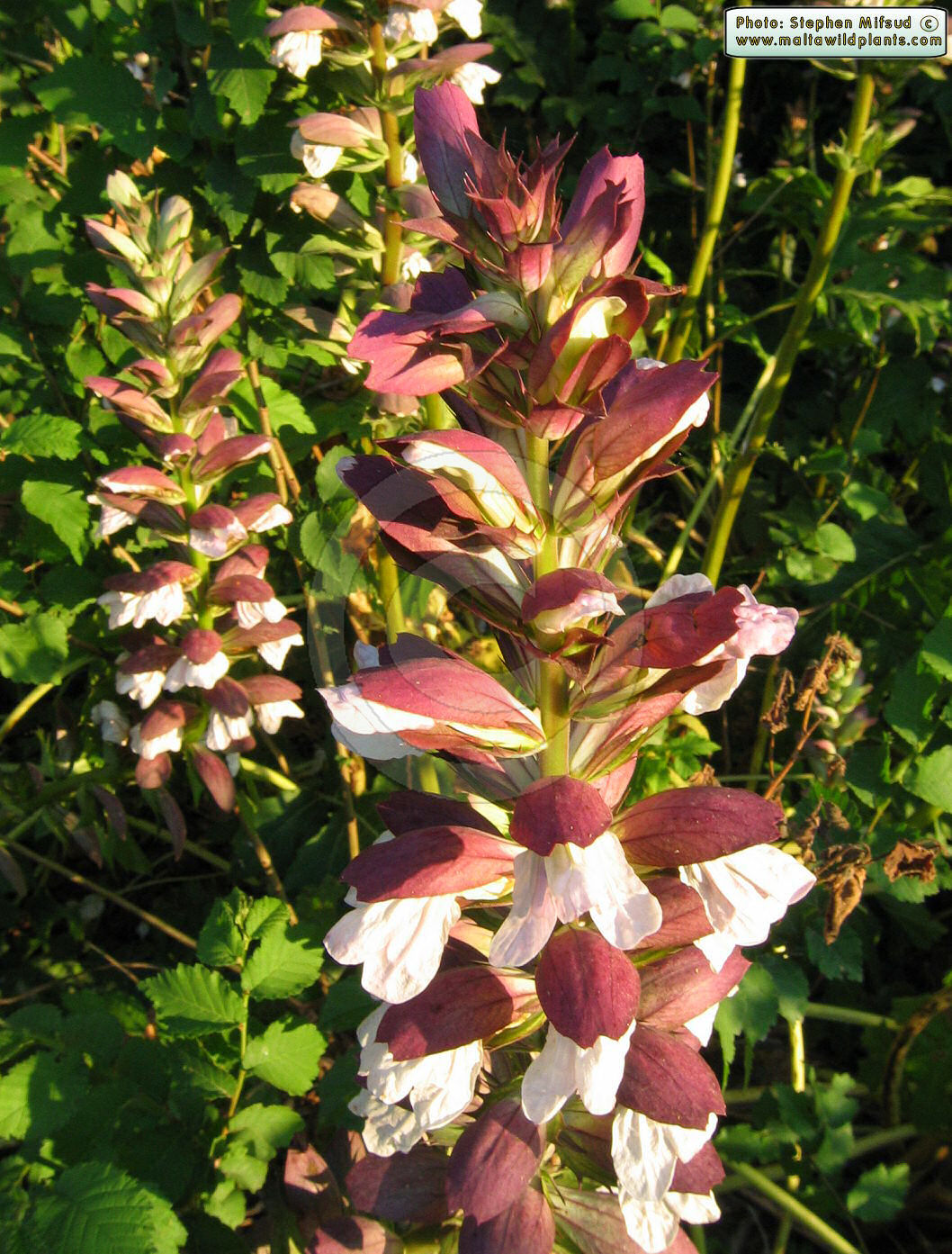
Photo of individual flowers which consists of a white labellum and purple brown sepals.
Acanthus mollis (Bear`s Breech) - CLICK TO ENLARGE PHOTO Acanthus mollis (Bear`s Breech) - CLICK TO ENLARGE PHOTO Acanthus mollis (Bear`s Breech) - CLICK TO ENLARGE PHOTO Acanthus mollis (Bear`s Breech) - CLICK TO ENLARGE PHOTO
Photo of individual flowers showing some of its internal parts, namely the large stamens.
Photo of individual young flowers with the petal still pleated. The colour of the petal is white and often with a touch of lavender / lilac tips or veins.
Photo of flowers from an upper view showing clearly the 3 lobes of the labellum and elongated hood-shaped upper sepal.
Close up photo of flower showing the large anthers and to some extent the conspicuous thick filaments.
Acanthus mollis (Bear`s Breech) - CLICK TO ENLARGE PHOTO Acanthus mollis (Bear`s Breech) - CLICK TO ENLARGE PHOTO Acanthus mollis (Bear`s Breech) - CLICK TO ENLARGE PHOTO Acanthus mollis (Bear`s Breech) - CLICK TO ENLARGE PHOTO
Close up photo of flower showing one of the 2 pairs of stamen with their large anthers touching each other.
Photo of buds at the apex of the flower spike.
Photo of buds (top view).
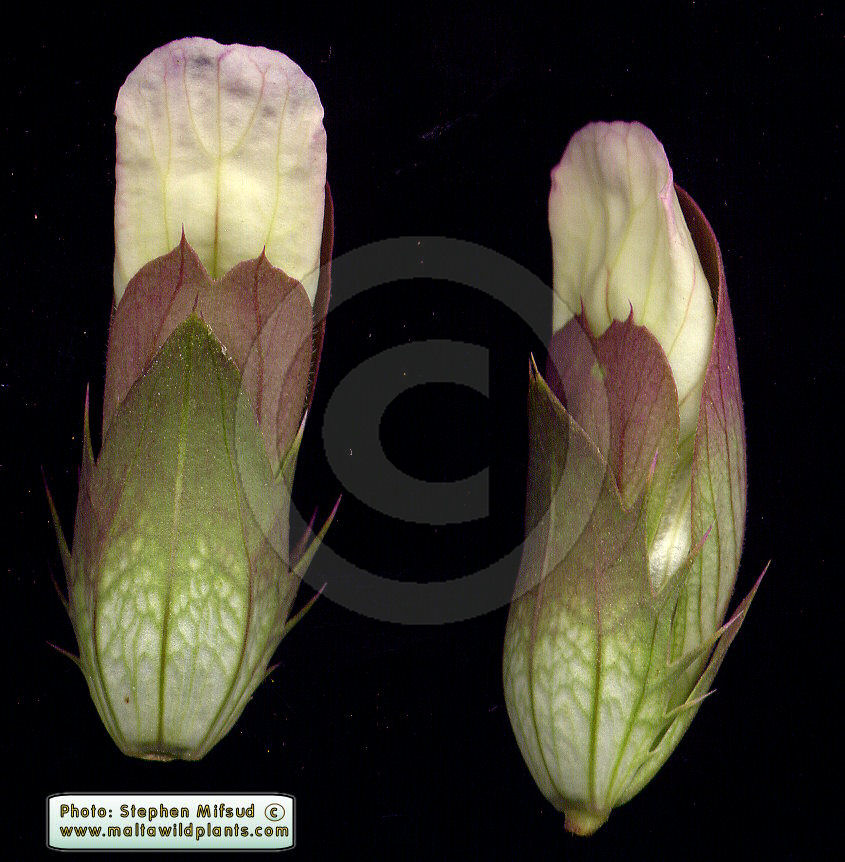
Scanned image of buds which have the single white petal pleated in a shape of a flattened closed cylinder. The lateral flap-like lobes will open sideways when the flower blooms.
Acanthus mollis (Bear`s Breech) - CLICK TO ENLARGE PHOTO Acanthus mollis (Bear`s Breech) - CLICK TO ENLARGE PHOTO Acanthus mollis (Bear`s Breech) - CLICK TO ENLARGE PHOTO Acanthus mollis (Bear`s Breech) - CLICK TO ENLARGE PHOTO
Scanned and annotated image of flower with the upper sepal folded backwards to show the internal parts.
Scanned image of flower with upper sepals removed to show the arrangement of the 4 stamens. These have the anthers touching and facing opposite each other. The stamens' filaments (especially the lower ones) are bent/coiled.
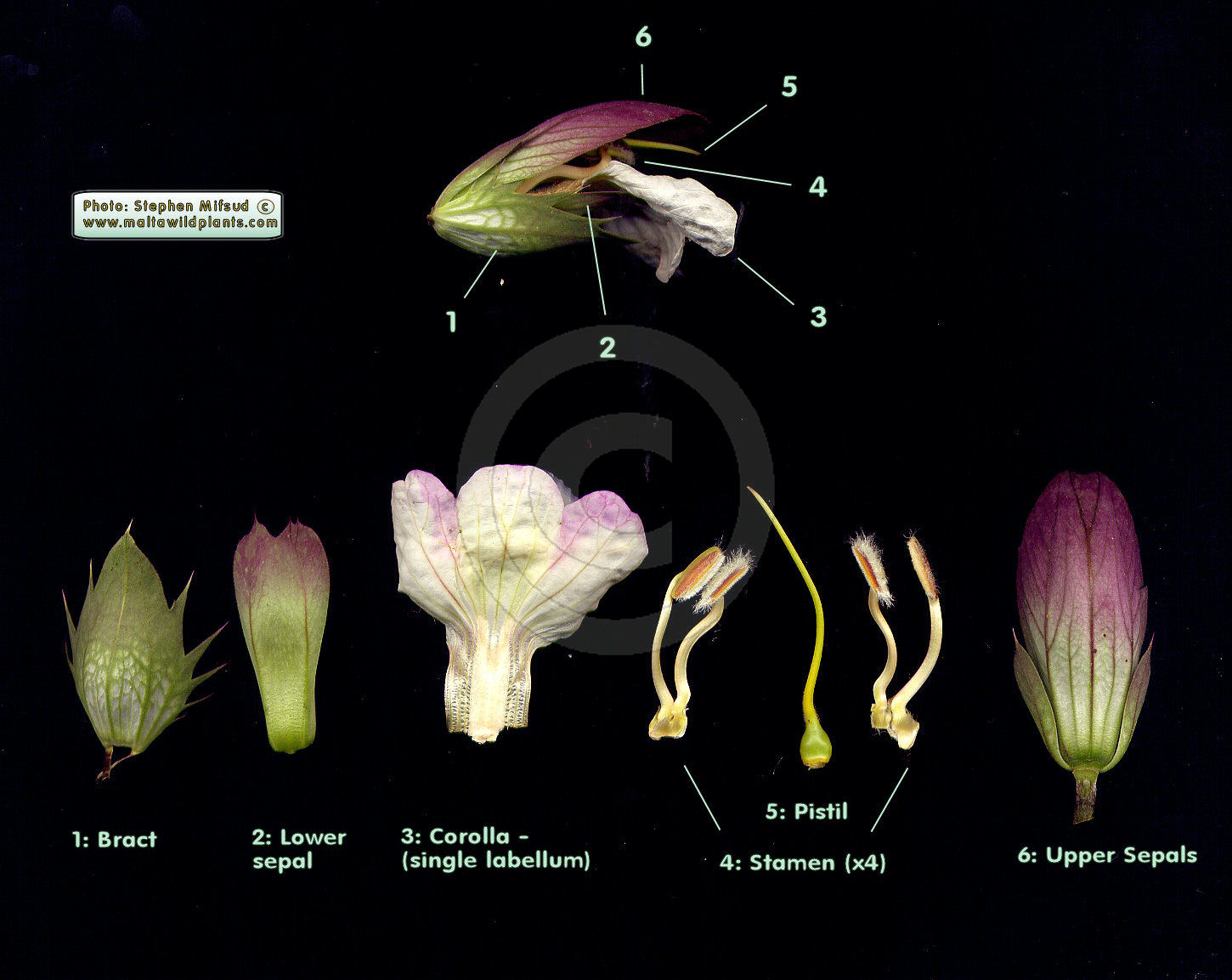
Anatomy of a complete flower. All the flower parts are dissected and are arranged in the flower as indicated. It consists of 1 toothed bract, 4 sepals (2 are very small), 1 labellum (petal) , 4 stamens and a central carpel.
Scanned image of the sepals and 3-lobed white labellum with a lavender tip. The sepals are green, with conspicuous veins and gets purple towards the outer part.
Acanthus mollis (Bear`s Breech) - CLICK TO ENLARGE PHOTO Acanthus mollis (Bear`s Breech) - CLICK TO ENLARGE PHOTO Acanthus mollis (Bear`s Breech) - CLICK TO ENLARGE PHOTO Acanthus mollis (Bear`s Breech) - CLICK TO ENLARGE PHOTO
Scanned image of the 4 stamens and green pistil. The filaments are thick, beige, and coiled while the anthers are, brown, large and flat, with yellow pollen liberated from one side of the anther, where there is a brush of fine white bristles.
Scanned image of the bract, which is oval shaped and have oppositely arranged, spiny teeth along the outline. This is the only part of the whole plant which has spines. The bracts also have a conspicuous green veins.
Photo of opposite bracts on the base of a flowering stem.
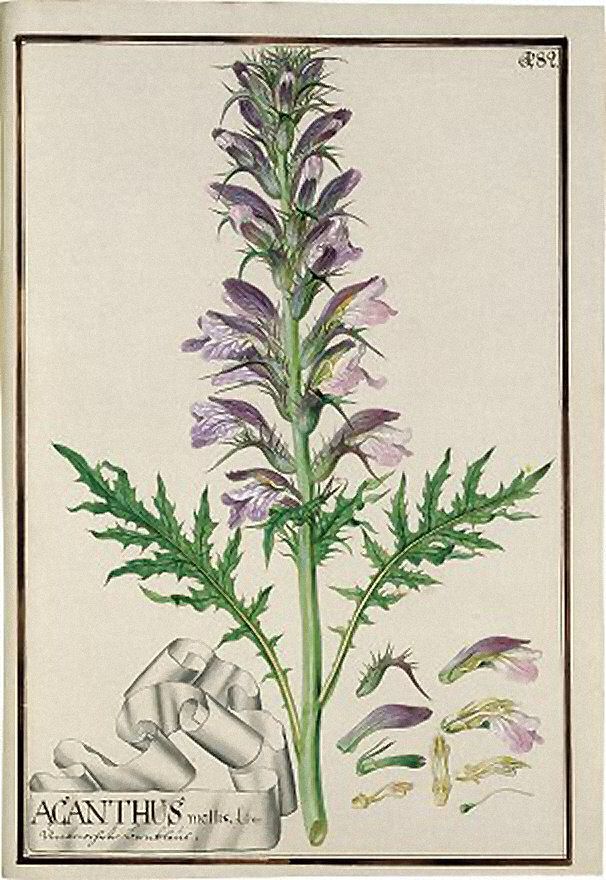
Coloured illustration of the plant taken from www.fuerstenhaus.li.
Acanthus mollis (Bear`s Breech) - CLICK TO ENLARGE PHOTO Acanthus mollis (Bear`s Breech) - CLICK TO ENLARGE PHOTO Acanthus mollis (Bear`s Breech) - CLICK TO ENLARGE PHOTO Acanthus mollis (Bear`s Breech) - CLICK TO ENLARGE PHOTO
Photo of leaf in situ. These can have very long stalks and can reach lengths up to 50cm. The whole length of the leaf (including stalk) can be up to 1 metre.
Photo of leaf having its characteristic oppositely running deep lobes, themselves having a lobed or shallow-dentate outline. The lower lobes reach to the midrib, making them appear as independant leaflets.
Photo of 2 large leaves lying on the ground. The mature leaves grow large and have long stalks. as a result, they bend down and rest lying on the ground.
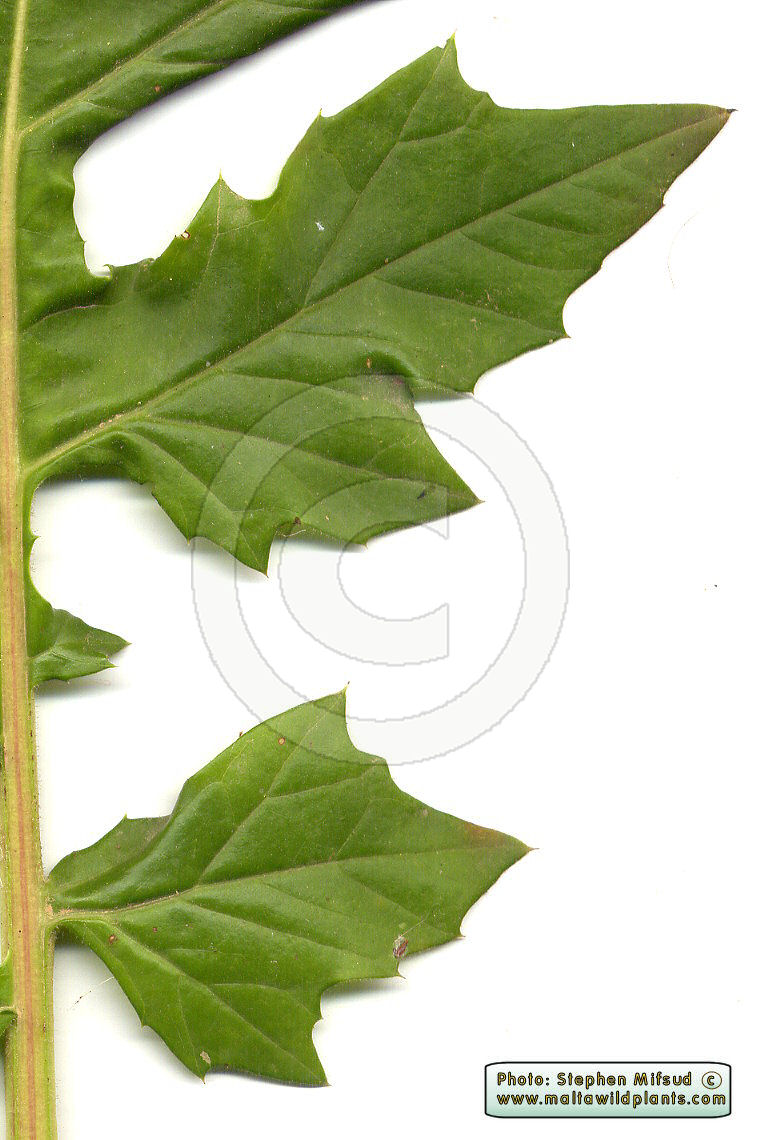
Scanned image of leaf (stalk partially cut out). The texture of the leaf is particularly soft and smooth. That's why plant is given the species name 'mollis' which means soft.
Acanthus mollis (Bear`s Breech) - CLICK TO ENLARGE PHOTO Acanthus mollis (Bear`s Breech) - CLICK TO ENLARGE PHOTO Acanthus mollis (Bear`s Breech) - CLICK TO ENLARGE PHOTO Acanthus mollis (Bear`s Breech) - CLICK TO ENLARGE PHOTO
Scanned image of one lobe of the leaf, itself also being lobed.
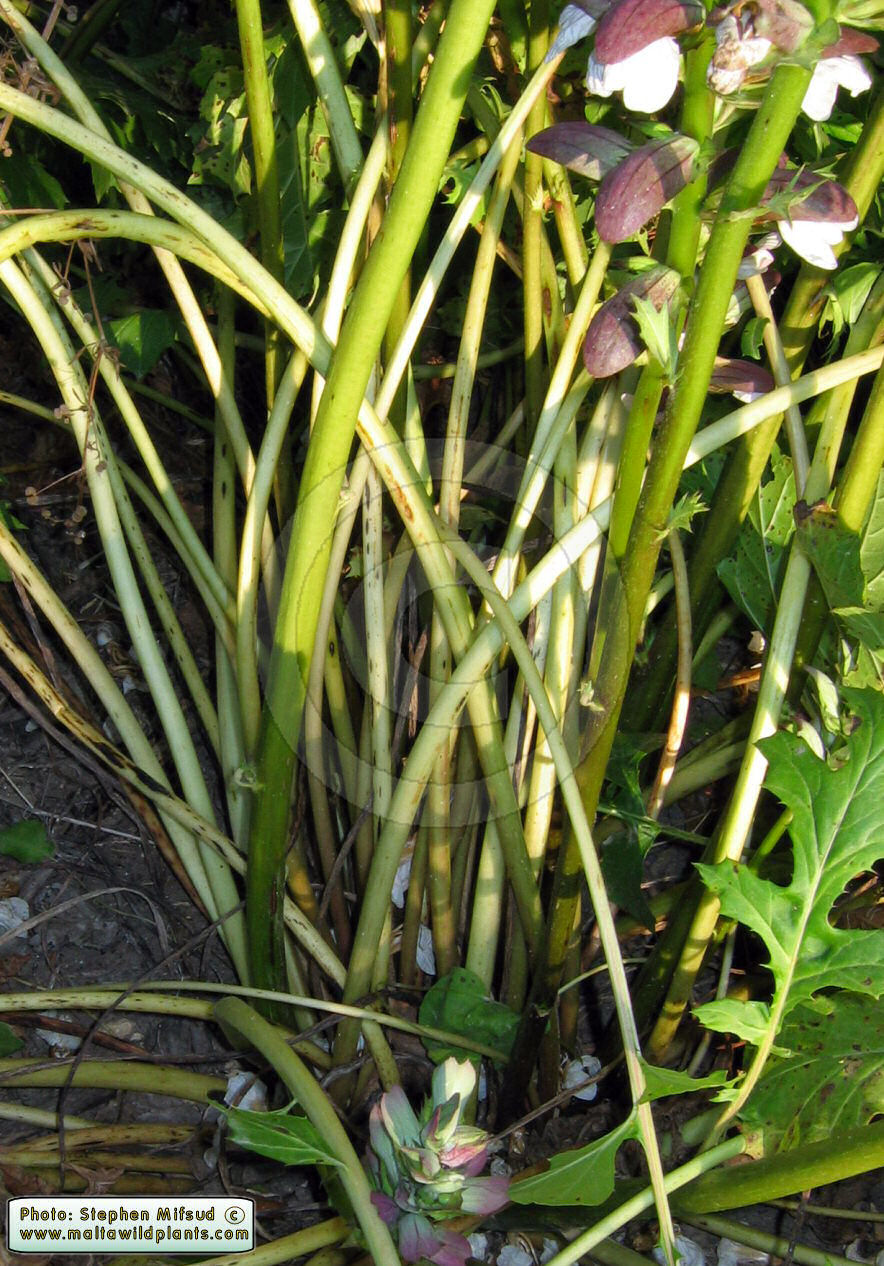
Plenty of long, bent stalks growing from the same spot, where the underground stem is located.
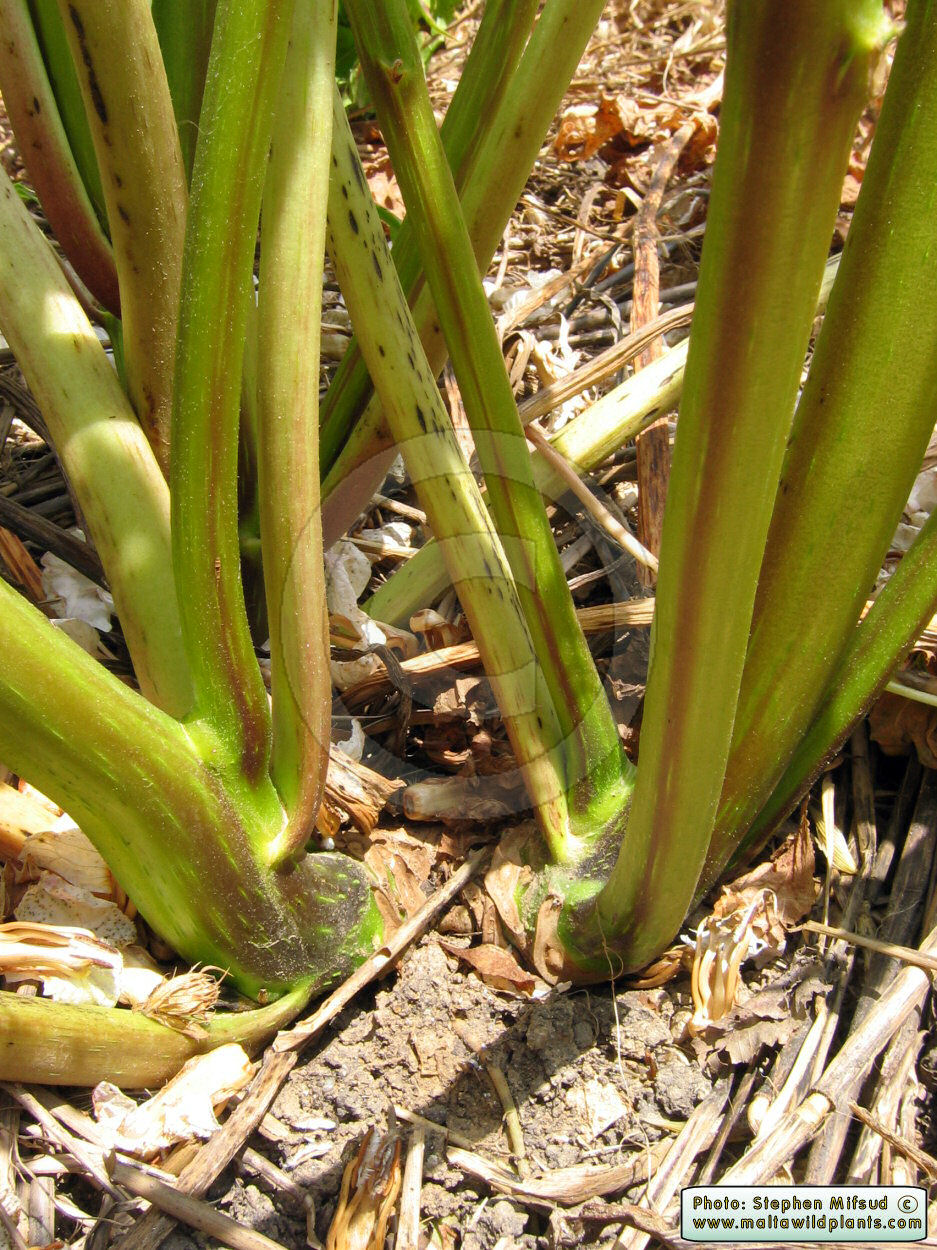
Photo of a portion of the underground stem which gives rise to several stalked leaves and flowering spikes.
Photo of the lower part of an adult flowering spike, forming green lemon-shaped fruit capsules. These grow up around 3 cm in length and when ripe they burst open and expel the reddish brown seeds away.
Acanthus mollis (Bear`s Breech) - CLICK TO ENLARGE PHOTO Acanthus mollis (Bear`s Breech) - CLICK TO ENLARGE PHOTO Acanthus mollis (Bear`s Breech) - CLICK TO ENLARGE PHOTO Acanthus mollis (Bear`s Breech) - CLICK TO ENLARGE PHOTO
Close up photo of a fruit capsule, still bearing the long style. The capsule is lemon shaped and glabrous (even shiny).
Photo of flower and one of its most common pollinators - this large black bee.
Photo of flower and a large bee which pollinates the flowers frequently. Other smaller bees which struggle and manage to enter the flower may find it impossible to get back out and remain trapped to death inside the flower.
Flowering spikes can reach very long heights. As seen in this example. The flower spike beside me may measure up to 200cm.
Acanthus mollis (Bear`s Breech) - CLICK TO ENLARGE PHOTO Acanthus mollis (Bear`s Breech) - CLICK TO ENLARGE PHOTO Acanthus mollis (Bear`s Breech) - CLICK TO ENLARGE PHOTO Acanthus mollis (Bear`s Breech) - CLICK TO ENLARGE PHOTO
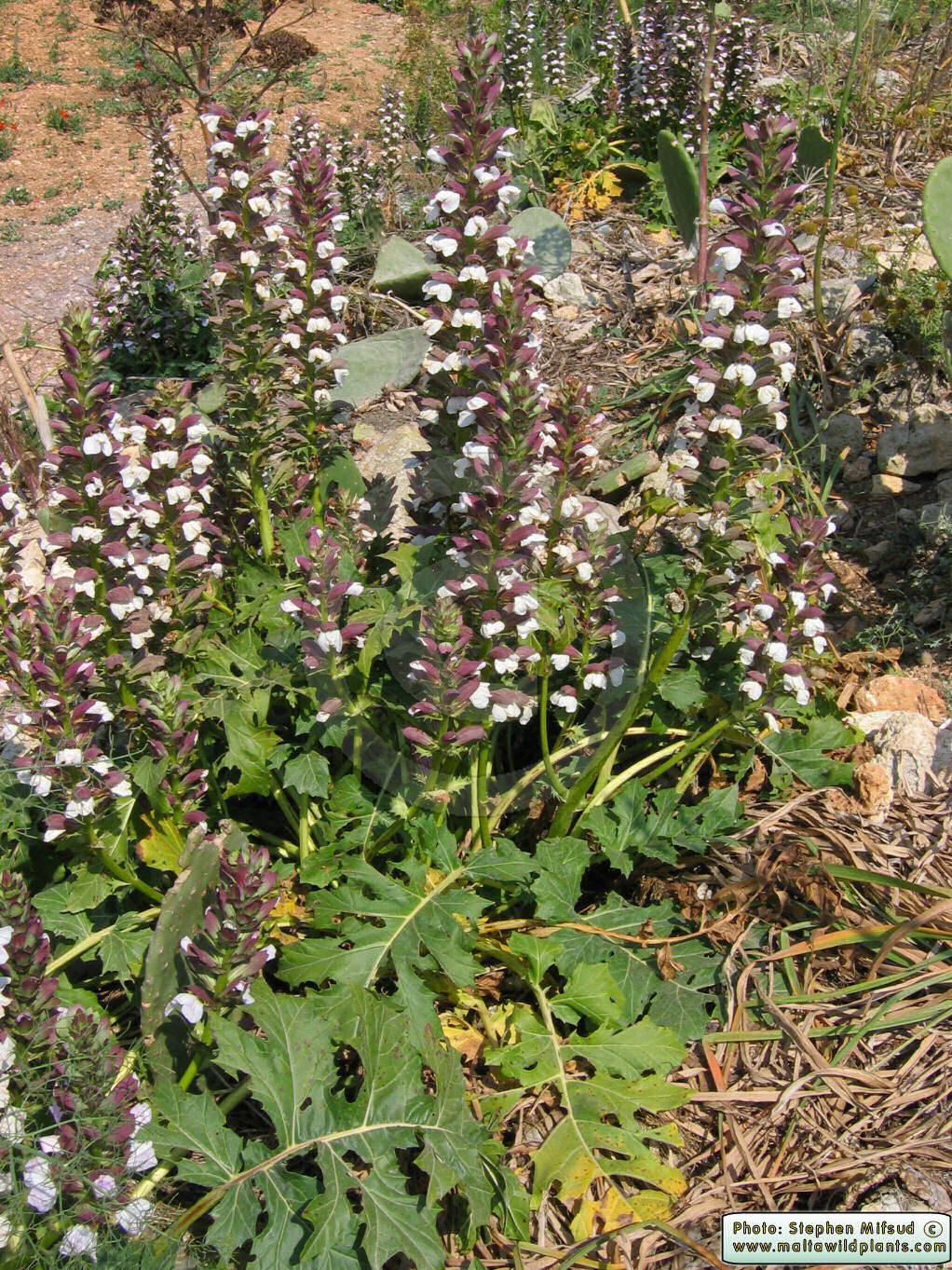
Photo of a typical plant - drooping long-stalked, large leaves and numerous flowering spikes of different lengths.
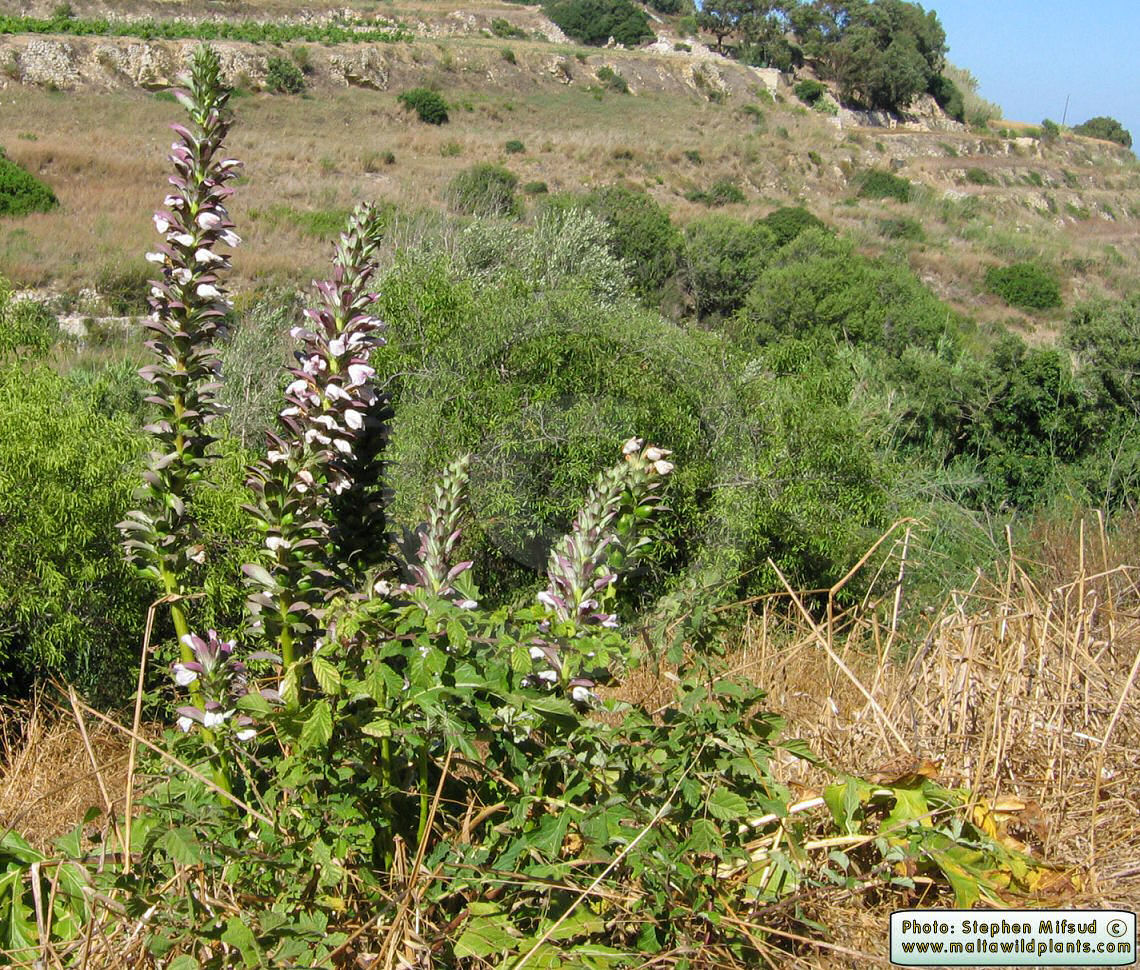
Photo of some plants near fields at Qattara (limits of Rabat).
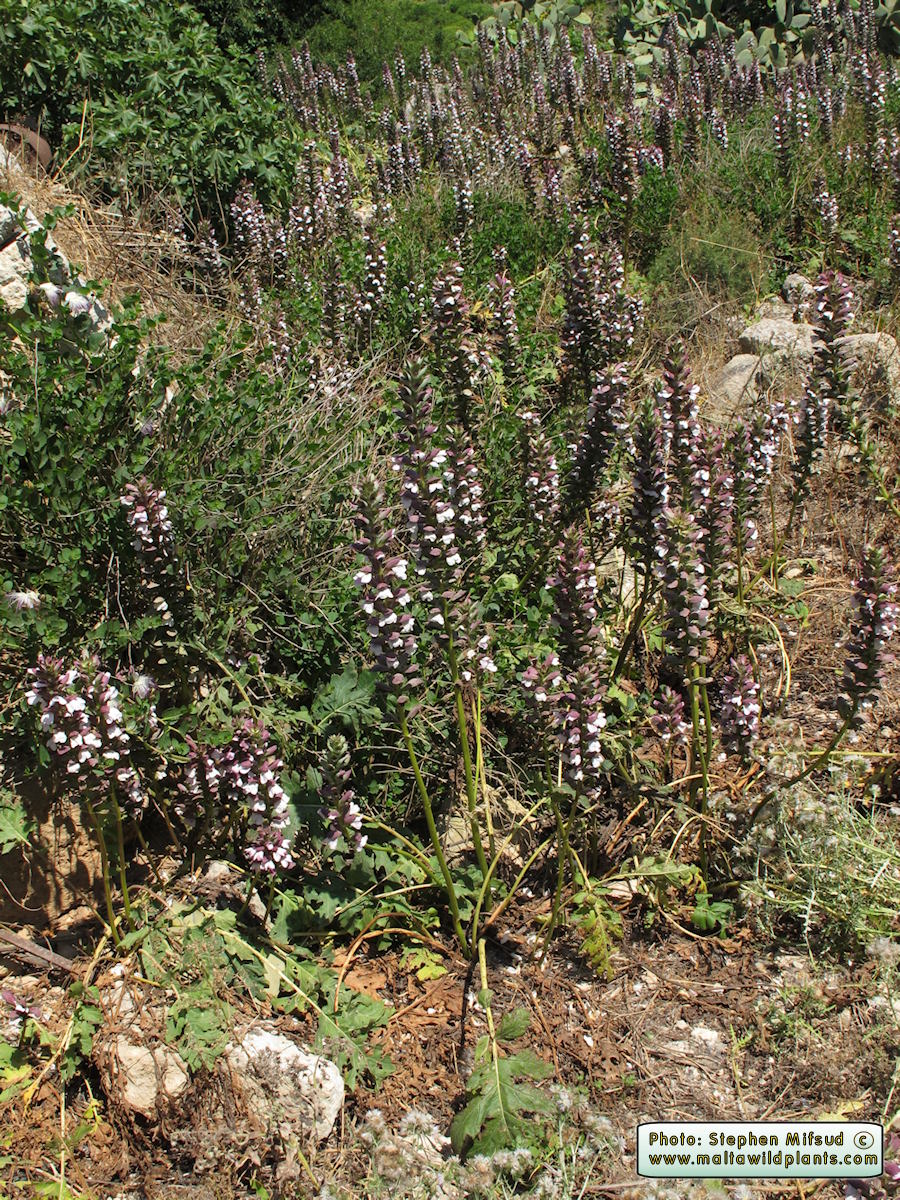
Photo of several flowering spikes.
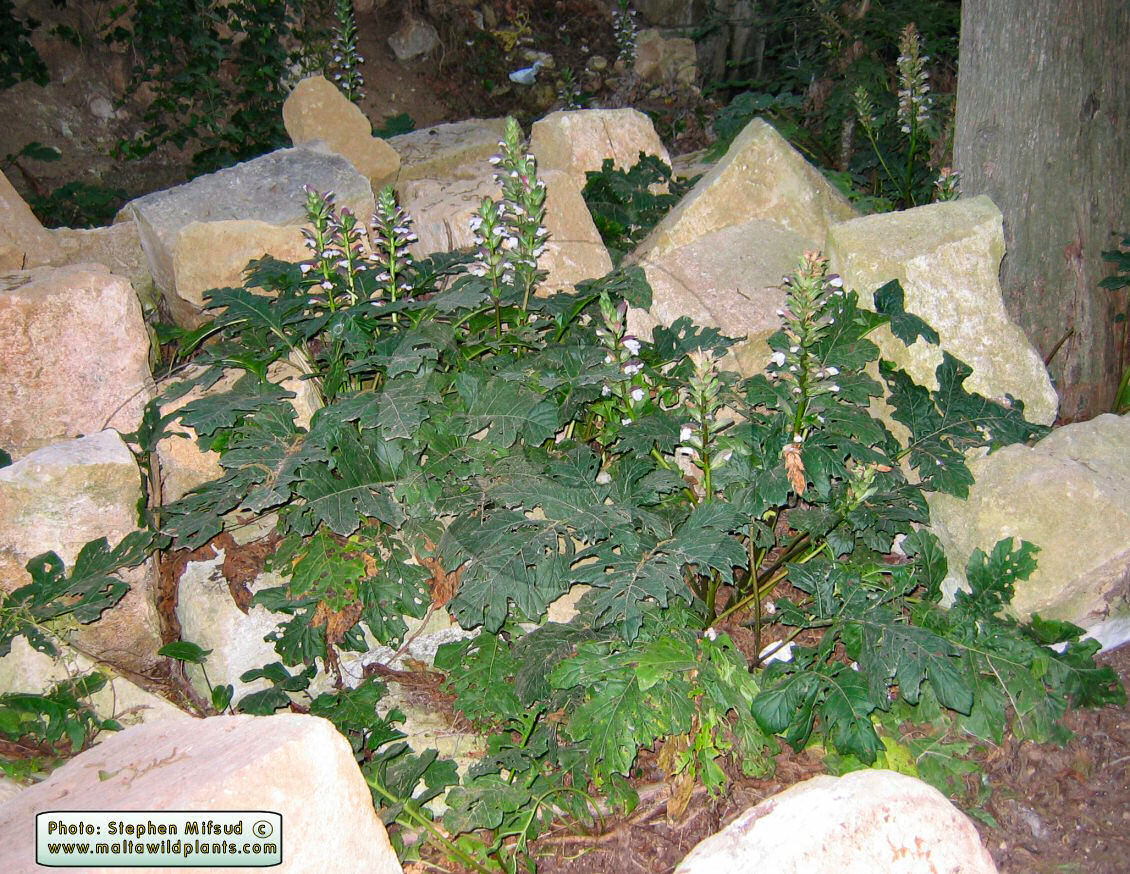
Photo of some plants besides some fallen limestone rocks. Since these plants like shade, they are often found under trees.
Acanthus mollis (Bear`s Breech) - CLICK TO ENLARGE PHOTO Acanthus mollis (Bear`s Breech) - CLICK TO ENLARGE PHOTO Acanthus mollis (Bear`s Breech) - CLICK TO ENLARGE PHOTO Acanthus mollis (Bear`s Breech) - CLICK TO ENLARGE PHOTO
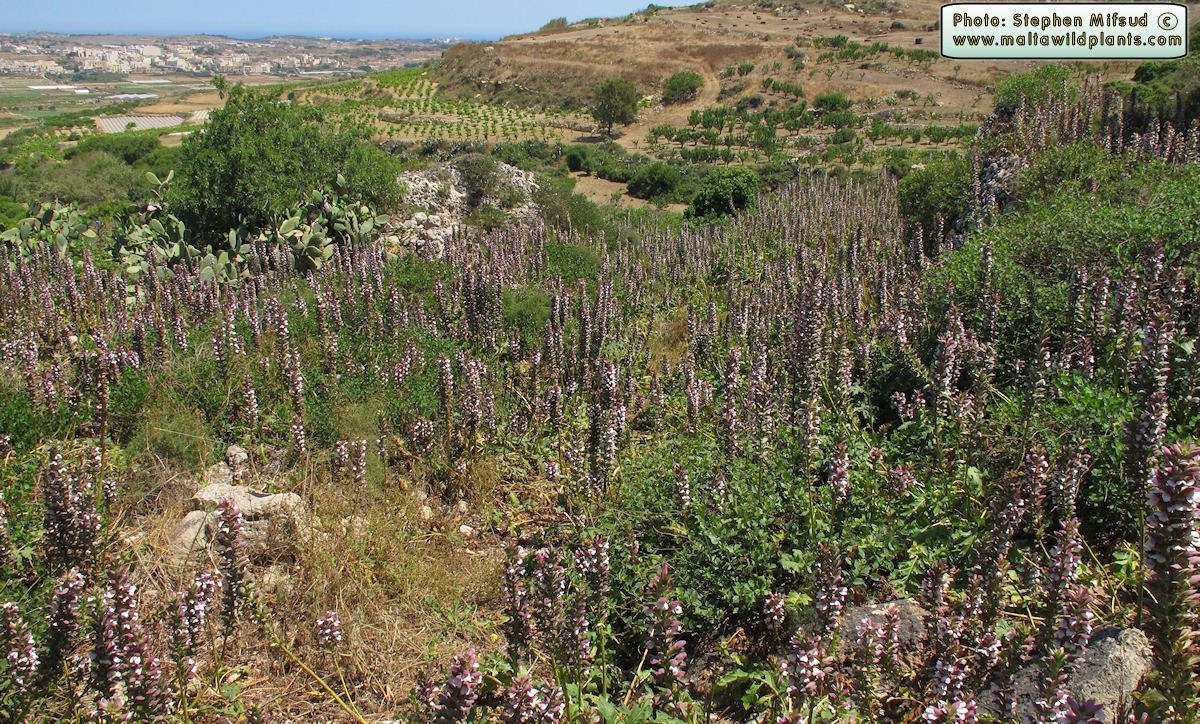
Habitat of the plant. This photo taken at Buskett Gardens where there are plenty of these plants at the end of Spring.
Photo of some plants near fields at Qattara, limits of Rabat (May04).
Scanned image of seeds. They have a flattened oval or circular shape, Their seed coat is often wrinkled but it can be also smooth. The colour is reddish brown.
Magnified image of pollen under microscope. They are oval (pod shaped) and have 3 longitudinal grooves. Picture taken from Flora apistica della Sicilia (by Prof. Nunzio Longhitano).

Further Information and Links

Propagation and general information about the plant Comments by gardeners from "The Plant's Database" homesite
Art and architecture of the Greeks Guidelines to the architecture of Greece
Illustrated architecture of Greece -
Search for Acanthus mollis on the FORUM of MaltaWildPlants.com
Detailed Medicinal Properties for Acanthus mollis


Buy from and support MaltaWildPlants.com

Buy Seeds from Maltawildplants.com Buy samples of seeds of certain wild plants for your studies, trials, research, etc. Not all species' seeds can be exported (depending on Maltese regulations), and availability depends on season of species. So, before any payment, you are kindly asked to fill in the online quotation/order form by which I can contact you back for availability and charges. Buy Seeds from Maltawildplants.com   Online Quotation

Buy Seeds from Maltawildplants.com   Online Payment
Buy Documents from Maltawildplants.com Buy documents related to Maltese Wild Plants such as the list of references, full profile, or other docs you request. Buy Documents from Maltawildplants.com   Online Payment
Buy Images  from Maltawildplants.com Buy any of my own copyright images found in this large collection of Maltese flora. You should first select the image you want to buy and input its corresponding code (found beneath each individual photo) in the online ordering form. Buy Seeds from Maltawildplants.com   Online Payment
Buy Seeds from Maltawildplants.com Kindly donate any sum of money (from 2USD / 2Euro) to help us covering some expenses needed to maintain Maltawildplants.com. Please bear in mind how much hard work such a large and up-to-date website needs to arrive directly to you home, office or library. Your kind donations are both greatly appreciated and recorded for future reference. Donors asking help will have first que preference for assistance and special attention. Buy Seeds from Maltawildplants.com   Online Donation


Submit More Information

Use the form below to submit more information about this plant or a related species. If the data is taken from a book, journal, website, etc, please provide the corresponding reference / website address as indicated in the form. If it is your own observation, then your name will be cited. Your Email address will never be displayed online, it is just for internal communication.


For plant species that are marked as rare, you can also report other locations in Malta where you have seen this species.

Finally you can report any mistakes or errors found on the plant profile for necessary corrections. This will help to improve the website's acuracy.


To have more details about each particular field, just move your mouse on it and wait for the help message to pop up

* = required fields.
Plant Species:  *
Your name:   *
Your Email:   *
Fill any of the following 3 sections below (A, B or/and C) and send the form. - Thank you.
 
A:  Additional Information about this plant species
Own observations:
Info from published material (books, jounals, website):

Reference of published material:

 
B:   Where have you seen this plant on the Maltese Islands?
Locations in Malta or Gozo where you have encountered this plant.
Mostly applies for rare plants.


1:        2:   
3:       4:   
5:       6:   

Try to be as concise as possible. Examples: Dingli Cliffs (near chapel), Wied Incita (Zebbug side), Triq il-Kbira (Qormi), Barriera ta\' Abdul (Xlendi), Fields near Salib tal-gholja (Siggiewi). GPS bearings are also welcomed!
 
C:  Corrections for mistakes and errors in this plant profile.
Section of this plant Profile page where you found an error (select one)

What is the error/mistake
What should be its correction


All material and data on this webpage is under the copyright of the author of this site - Stephen Mifsud / www.MaltaWildPlants.com / Malta. (2002-2008)
This research project about the flora of Malta is sponsored by:
Middlesea Insurance p.l.c. A Fund established to help in the amelioration and enhancement of the environment in Malta and to take initiatives that enhance awareness on environmental issues amongst the public Empty space for sponsor Empty space for sponsor Benefit companies get by sponsoring this project